This article contains affiliate links. If you purchase or book through these links, we may earn a commission at no additional cost to you.
The remote work revolution has fundamentally shifted how we view our homes. For many women balancing careers, side hustles, and household management, the “home office” often translates to a chaotic corner of the dining table or a laptop balanced precariously on the sofa. But as the work-from-home lifestyle cements itself as a permanent fixture, the need for a dedicated, distraction-free zone has never been more pressing.
If you are scanning your floor plan and seeing zero extra square footage, stop looking at the spare rooms you don’t have and start looking at the storage you do have. Enter the “Cloffice” (Closet Office), the ultimate design hack for the space-starved remote worker.
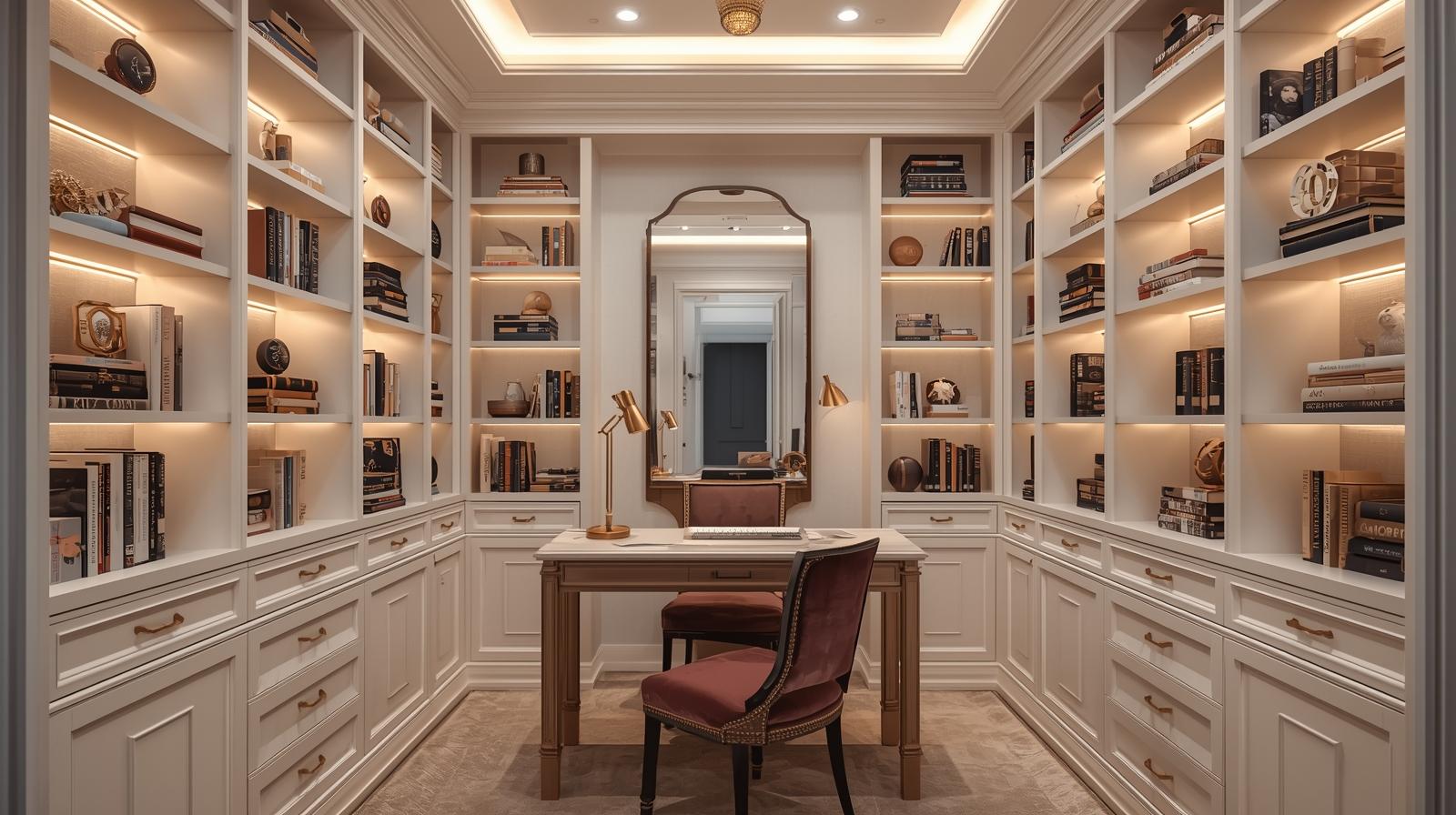
Transforming a walk-in closet into a luxury office isn’t just about shoving a desk where your winter coats used to hang. It is an exercise in intentional design, small-space optimization, and psychological separation between “living” and “working.” With the right approach and a little digital planning, you can turn a 5×5 storage unit into a boutique headquarters.
Phase 1: The Great Purge and Prep
Before you can introduce luxury, you must eliminate chaos. A walk-in closet is often a catch-all for “I might wear this someday” items and bulky luggage. To reclaim this space, you need to be ruthless.
Begin by emptying the space entirely. This is non-negotiable. You need to see the bare bones of the architecture, the location of the outlets, the height of the baseboards, and the quality of the flooring. If you are keeping clothes in the space (a hybrid cloffice), they need to be categorized and condensed. Consider moving off-season items to under-bed storage or switching to a capsule wardrobe to free up vertical wall space.
Once the space is empty, treat the walls. Closets are often neglected, featuring scuffed matte white paint. To elevate the space to “luxury” status immediately, apply a fresh coat of high-quality paint or, even better, a bold, peel-and-stick wallpaper. Since the square footage is small, you can afford high-end materials that would be cost-prohibitive in a living room. A moody charcoal, a soft blush pink, or a textured grasscloth can instantly make the small box feel like a jewel box.
Phase 2: The Digital Blueprint (Don’t Guess, Visualize)
The biggest mistake people make when designing a cloffice is buying furniture that almost fits. In a small space, “almost” is a disaster. A desk that is two inches too deep can prevent the door from closing. A chair that is too wide can make you feel claustrophobic.
This is where technology saves the day. Before you buy a single item, you need to model the space. Using a digital interior design tool allows you to switch between 2D and 3D views, a crucial step for avoiding costly mistakes.
The 2D View: The Logistics Check
Start in the 2D view (the floor plan mode). This is where you focus purely on clearance and flow.
- The Door Swing: Closets usually have doors that swing inward, which eats up valuable floor space. In 2D, you can map out exactly where the door edge stops. If your desk overlaps with this arc, you need a smaller desk, or you need to remove the door entirely and replace it with a curtain or sliding barn door.
- The “Ejection” Path: You need to ensure you can physically roll your chair back to stand up without hitting the back wall. In a standard walk-in, you need at least 30 to 36 inches of clearance behind the desk for comfortable movement. The 2D grid allows you to count the inches precisely.
The 3D View: The Vibe Check
Once the layout works mathematically, switch to 3D view. This is about aesthetics and psychology.
- Vertical Volume: A closet has no windows, so it can feel cave-like. In 3D, you can test how tall bookcases or floating shelves will look. Does a cabinet above the desk make the ceiling feel lower?
- Texture and Light: 3D visualization helps you see how your wallpaper interacts with your flooring. You can “walk” through the room virtually to see if the space feels cozy and encapsulated (good) or cramped and suffocating (bad). This is the best way to audit the “luxury” feel before spending a dime.
Phase 3: Strategic Furniture Selection
In a cloffice, furniture must do double duty. You do not have the luxury of purely decorative pieces; everything must be functional.
The Desk: This is the anchor. Avoid heavy, blocky desks with modesty panels, as they close off the visual space. Opt for legs that are slender or made of acrylic or glass to keep the sightlines open. If the closet is particularly narrow, a custom-cut piece of butcher block mounted on wall brackets can span the entire width of the closet, eliminating leg obstructions entirely.
The Chair: Comfort is queen, but scale is king. An executive leather high-back chair might look powerful, but it will dominate a small closet. Look for mid-back task chairs with a slim profile. Ensure the arms of the chair can slide under your desk so you can push it all the way in when you’re done working.
Storage: Verticality is your best friend. Since floor space is premium, go up. Floor-to-ceiling shelving draws the eye upward, making the ceiling feel higher. Use uniform bins or baskets to hide clutter, visual noise is the enemy of a small workspace.
Design Tip: Struggling to find pieces that fit tight dimensions? Explore the extensive Planner 5D’s furniture catalog to find desks and smart storage solutions specifically modeled for varied spatial constraints.
Phase 4: Lighting the Cave
The defining characteristic of a closet is usually a lack of natural light. If you don’t address this, your office will feel like a dungeon, which is detrimental to both productivity and mood. You need to layer your lighting to mimic a bright, airy room.
- Overhead: Replace the standard “boob light” flush mount with a statement fixture. A small chandelier or a modern geometric pendant draws the eye up and adds that touch of luxury. Ensure the bulbs are “Daylight” (5000K) rather than “Soft White” (2700K) to keep you alert.
- Task Lighting: You likely don’t have room for a massive lamp base on your desk. Use sconces. Plug-in wall sconces flanking your monitor not only look high-end and hotel-like, but they also free up precious desk surface.
- Bias Lighting: Install LED strip lights behind your monitor or under your floating shelves. This reduces eye strain and adds a modern, architectural glow to the room.
Phase 5: The Luxury Details
Now that the function is secured, bring in the form. What makes an office feel “luxury” isn’t the size; it’s the finishings.
- The Rug: A plush, high-pile rug covers up utilitarian closet flooring and adds warmth underfoot. It also helps dampen sound, vital if your closet is near a noisy hallway or bedroom.
- Cord Management: Nothing kills a luxury vibe faster than a rat’s nest of cables. Invest in a cable management box, velcro ties, and paintable cord covers. In a small space, messy wires are magnified.
- Art and Mirrors: Hang a large mirror on the wall behind you or on the side wall. It reflects light and tricks the brain into thinking the room is twice as deep. Add a piece of art that you genuinely love, this is your private sanctuary, after all.
- Scent: Luxury is multisensory. A high-quality reed diffuser (safer than candles in a small, enclosed space) with notes of bergamot, sandalwood, or eucalyptus can make entering your office feel like stepping into a spa.
The Mental Separation
Perhaps the most luxurious aspect of the cloffice is the ability to close the door. When the workday is done, you can physically shut away the stress, the emails, and the to-do lists. In an era where work and life are hopelessly blurred, that door is a boundary. It tells your brain: Work is over. Life begins.
By utilizing smart planning tools to check your 2D clearances and 3D aesthetics, and investing in the right scale of furniture, you can turn the most overlooked square footage in your house into its most valuable asset. The cloffice isn’t just a trend; it’s a masterclass in making your home work for you.