This article contains affiliate links. If you purchase or book through these links, we may earn a commission at no additional cost to you.
We have all been there. You are standing in the middle of your living room, holding a tape measure that keeps snapping back at your fingers, trying to visualize a three-seater sofa that you saw on a website. You have the dimensions scribbled on a notepad, and you have taped out a rough rectangle on the floor with blue painter’s tape. You squint, tilting your head, trying to imagine if that “Midnight Blue” velvet will clash with your curtains or if the chaotic energy of the rug will overwhelm the piece.
Eventually, you sigh, cross your fingers, and hit “Buy Now”.
Two weeks later, the delivery truck arrives. The sofa is hauled up three flights of stairs, unwrapped, and placed in the spot. And immediately, your heart sinks. It’s too bulky. The blue looks more like a bruised purple in your living room lighting. It blocks the flow of traffic to the kitchen.
Now begins the arduous, expensive, and carbon-heavy process of the return.
This scenario, played out in millions of homes annually, is the backbone of the “Return Culture” that plagues the furniture industry. However, a technological shift is underway that promises to banish the tape measure to the junk drawer and make “buyer’s remorse” a relic of the past. Augmented Reality (AR) is not just a gimmick for catching virtual monsters in the park anymore; it is the new standard for how we furnish our lives.
The Imagination Gap
The fundamental problem with buying furniture online has always been the “Imagination Gap.” Traditional e-commerce relies on 2D images to sell 3D objects. No matter how high-resolution the photo, or how 360-degree the view, a screen cannot convey scale or context.
When we shop for clothes online, we know our size. Even if the fit isn’t perfect, the logistical cost of returning a t-shirt is negligible. Furniture is different. It is spatial. It requires a relationship with the room it inhabits. A coffee table doesn’t just exist in a vacuum; it exists in relation to the sofa, the rug, the wall color, and the natural light hitting it from the window.
For decades, we relied on our brains to bridge this gap. We tried to mentally superimpose images onto our reality. But human brains are notoriously bad at estimating spatial volume. We underestimate how much space a sectional takes up, or we overestimate the height of a dining chair. This cognitive disconnect is expensive. Return rates for online furniture purchases are significantly higher than brick-and-mortar sales, often hovering between 5% and 10% for large items, with some categories spiking much higher.
This is where Augmented Reality steps in to close the gap.
The “Point and Place” Revolution
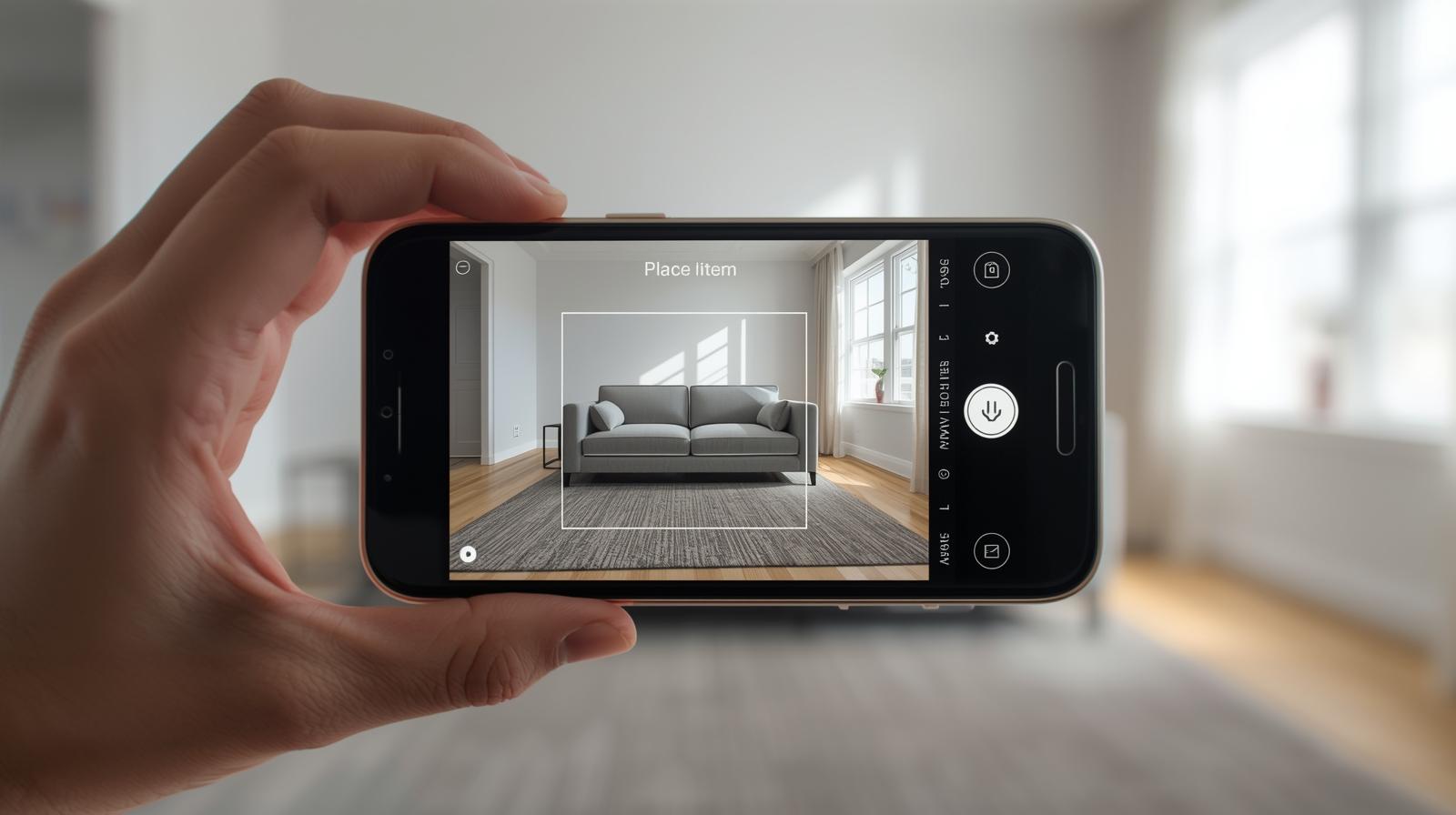
Augmented Reality in furniture shopping changes the user interaction from “imagining” to “seeing.” The premise is deceptively simple: you hold up your smartphone or tablet, point the camera at your empty corner, and select a piece of furniture from a catalog.
Through the screen, that furniture appears in your room.
But it doesn’t just float there like a sticker on a photo. Thanks to advancements in SLAM (Simultaneous Localization and Mapping) and LiDAR (Light Detection and Ranging) sensors found in modern devices, the device understands the geometry of your floor. It detects the plane. It understands the scale.
When you drop that virtual armchair into your living room through an AR app, it lands on the floor with accurate scale. If you walk closer to it with your phone, the chair gets larger, just as a real object would. If you walk around it, you see the back. You can check if the legs of the table will slide under your sofa, or if the lamp is too tall for your reading nook.
This is the “Point and Place” revolution. It transforms the customer from a passive viewer of photos into an active participant in designing their space.
The Tech Behind the Magic
For the Tech Enthusiasts reading this, the rapid maturation of this technology is nothing short of fascinating. Early iterations of AR were clunky. Objects would drift, floating ghost-like through walls or hovering six inches off the floor. They lacked “occlusion” – the ability for the virtual object to hide behind a real object (like a table leg hiding behind a real-world ottoman).
Today, the compute power in our pockets allows for real-time rendering of complex textures and lighting. Modern AR frameworks, like Apple’s ARKit and Google’s ARCore, analyze the environment to estimate ambient light. This means the virtual sofa casts a shadow on your real floor. The fabric texture responds to the light direction.
This high-fidelity visualization is crucial. It’s not enough to know if the sofa fits physically; shoppers need to know if it fits aesthetically. Does the wood grain of the virtual credenza clash with the real hardwood floors? AR answers that question instantly.
Sustainability and the Death of “Return Culture”
While the “cool factor” of AR is undeniable, the economic and environmental implications are the real story here. “Return Culture” is an invisible ecological disaster.
When you return a pair of jeans, they might get repackaged and resold. When you return a 200-pound solid oak dining table, the carbon footprint is massive. That table has to be repackaged (often requiring new materials), loaded onto a freight truck, driven back to a warehouse, inspected, and often, because of minor damage during transit or the high cost of refurbishment, it ends up in a landfill.
Reverse logistics in the furniture industry is a nightmare. It eats into retailer margins and contributes significantly to global emissions.
AR acts as a preventative filter. By allowing customers to “try before they buy” in a hyper-realistic manner, retailers are seeing a drastic reduction in returns. When a customer can see exactly how tight the clearance is between the bedframe and the door, they don’t buy the wrong size. When they can see that the “Forest Green” upholstery makes their room look too dark, they switch to “Sage” before the credit card is charged.
This shift from reactive returns to proactive visualization is making e-commerce sustainable for bulky goods. It turns the shopper’s living room into the showroom, eliminating the guesswork that leads to returns.
Empowering the Inner Designer with Planner 5D
This technology is no longer limited to high-end enterprise solutions; it is available to anyone with a smartphone. One of the frontrunners democratizing this technology is Planner 5D.
Planner 5D goes beyond simple object placement; it offers a comprehensive ecosystem for home design. Whether you are remodeling a house, renovating a kitchen, or just trying to figure out if a king-size bed will fit in your new apartment, this tool bridges the gap between professional CAD software and intuitive consumer apps.
With their advanced AR features, you can instantly visualize how different layouts work in your actual space. You aren’t just guessing; you are planning with precision. The app allows users to create detailed 2D and 3D floor plans, but the magic happens when you switch to the AR mode to see those designs come to life around you.
If you are tired of the tape measure struggle and want to see the future of furniture shopping in your own home, you can try it out today.
Download Planner 5D for iOS and Android here
The Psychological Shift: Confidence in Purchasing
Beyond the logistics and the tech, AR solves a psychological barrier: the fear of commitment.
Furniture is expensive. For many shoppers, buying a sofa is a multi-year investment. The anxiety of making the “wrong” choice often leads to analysis paralysis, where the shopper abandons the cart entirely.
AR provides what psychologists call “technological reassurance”. By validating the purchase in the user’s actual environment, the technology confers a sense of ownership before the transaction even takes place. This is known as the “Endowment Effect”, once you see that virtual desk in your office, customized to your liking, you psychologically feel like it’s already yours. The hesitation fades.
This is why conversion rates for customers who use AR features are significantly higher than those who just view static images. We are visual creatures. We need to see it to believe it.
What’s Next? The Future of Spatial Commerce
We are currently in the early adoption phase of AR in retail, but the trajectory is clear. As wearable tech (like smart glasses) becomes more ubiquitous, the experience will become even more frictionless. We won’t need to hold up a phone; we will simply look at a corner of the room, gesture with our hand, and cycle through different armchair options instantly.
We can also expect deeper integration of AI. Imagine pointing your camera at your current living room, and an AI assistant suggests a coffee table that perfectly matches your existing decor style, then places it in the room via AR for you to approve.
The days of crossing our fingers and hoping the furniture fits are numbered. The “Return Culture” that wasted time, money, and fuel is being dismantled, one virtual sofa at a time. The future of shopping isn’t about going to a store; it’s about bringing the store to you, pixel by perfect pixel.
So, will that sofa fit? With AR, you’ll know the answer before you ever click “Buy.”