This article contains affiliate links. If you purchase or book through these links, we may earn a commission at no additional cost to you.
Welcome to the shoebox era of your life. You’ve got your acceptance letter, you’ve met your roommate (digitally, at least), and you’ve bought enough instant noodles to survive a nuclear winter. But now you’re facing the final boss of university prep: the dorm room.
Most dorms are roughly 150 square feet. That is not a lot of real estate. To put it in perspective, that’s about the size of a standard parking space. Into this parking space, you must fit your bed, your clothes, your study setup, your hobbies, your social life, and arguably your sanity.
If you just toss your stuff in there, you will be living in a clutter cave by mid-semester. But if you approach this 150 square feet with strategy and a bit of architectural cunning, you can turn that cramped quarter into a functional, multi-layered studio apartment. The secret isn’t minimizing your life; it’s maximizing your verticality.
Here is the ultimate guide to hacking your dorm room, from the floorboards to the ceiling tiles.
Phase 1: The Loft Bed (Your New Penthouse)
Let’s get the most controversial opinion out of the way first: If your university allows it, you must loft your bed.
There is a resistance to loft beds. They remind people of bunk beds at summer camp. They require climbing a ladder to go to sleep. But in the economy of dorm square footage, a floor-level bed is a luxury you cannot afford. A twin XL bed takes up about 20 square feet of floor space. In a 150-square-foot room, that is over 13% of your total living area.
By raising your bed, you aren’t just sleeping higher; you are doubling your floor plan in that specific zone. You are reclaiming that 13%.
The Configuration Game
Don’t just raise it blindly. You need to choose a configuration that matches your lifestyle (or your “aesthetic,” if you will).
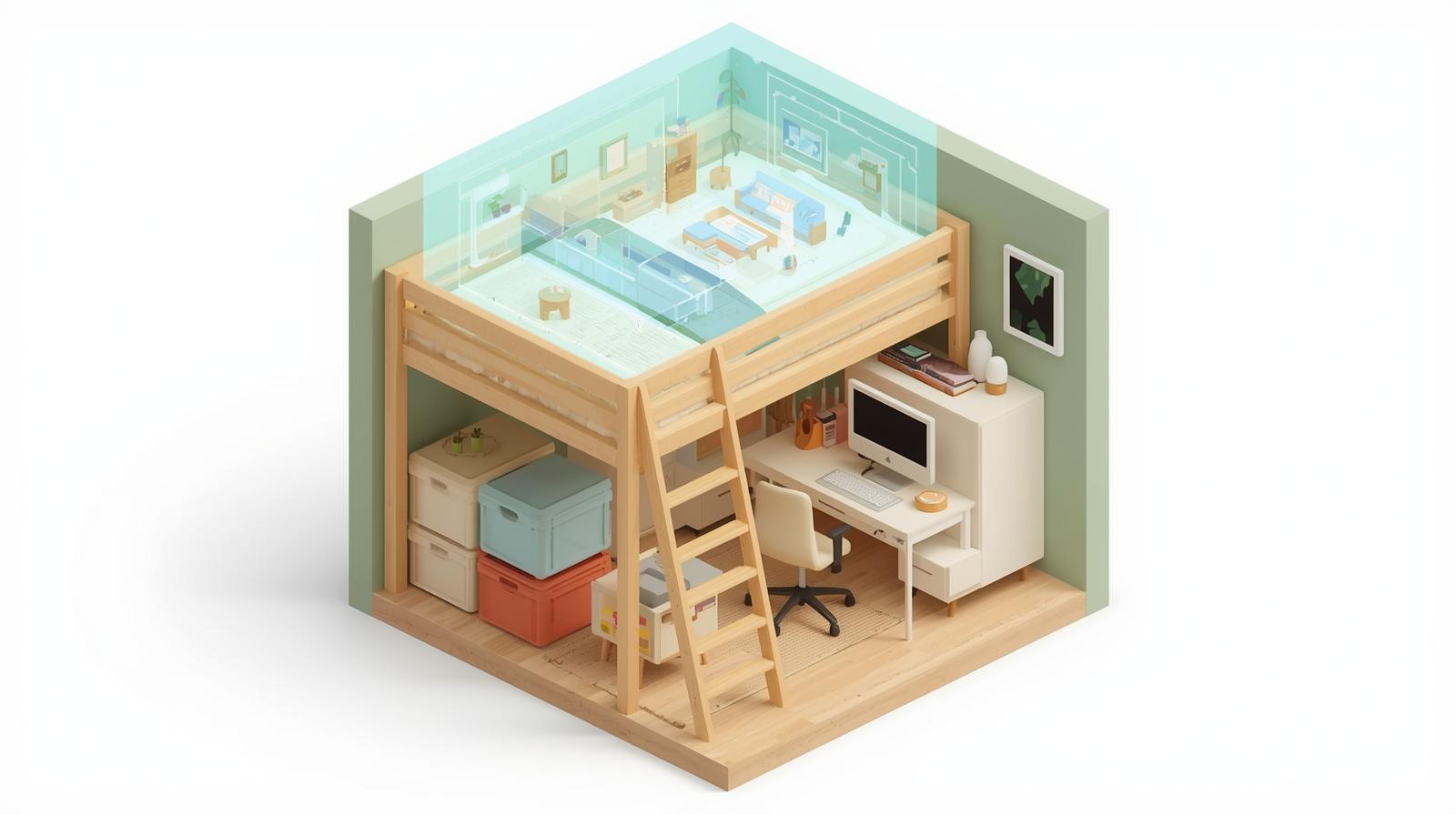
- The “Study Bunker” Configuration: This is the most common setup. You lift the bed to its maximum height and place your desk underneath. This creates a distinct separation between “rest” and “work,” which is psychologically crucial when you live in one room. It effectively creates a two-room suite: the bedroom upstairs and the office downstairs.
- The “Social Lounge” Configuration: If you prefer to study at the library, use the space under your loft bed for living. Throw down a cheap rug, a bean bag chair, and maybe a small TV or monitor. Suddenly, your room is the hangout spot. You have a “living room” in a room that shouldn’t legally be large enough to have one.
- The “Walk-In Closet” Configuration: For the fashion majors or the heavy packers, the space under a loft bed can accommodate a second dresser and a hanging rack. Enclose it with a tension rod and a curtain, and you have a private changing area and hidden storage.
Phase 2: The Under-Bed Ecosystem (The “Basement”)
If you absolutely cannot loft your bed, maybe you have a fear of heights, or the ceiling is too low—you must treat the space under your bed as a high-security vault. This is not the place where dust bunnies go to die; this is your “basement.”
The biggest mistake students make is stuffing random loose items under the bed. Two weeks later, you lose a shoe, three textbooks, and a bag of chips into the void. You need a system.
Rolling Carts are Essential
Avoid heavy, static boxes if you can. Opt for rolling storage bins or drawers. Dorm rooms are dynamic; you will be moving things around constantly. Being able to roll your “pantry” or your “winter clothes” out from under the bed with one hand is a game-changer.
The Bed Riser Hack
If your bed is not lofted but sits too low for good storage, invest in bed risers. These durable plastic or wood blocks lift the bed frame by 5 to 7 inches. It sounds minimal, but that extra height is the difference between fitting a standard plastic tote bin and not fitting anything at all. Some risers even come with built-in USB outlets, a massive win for charging your phone while you doom-scroll in bed.
The “Skirt” Trick
Visual clutter makes a small room feel smaller. Even if your under-bed storage is organized, seeing twenty different plastic bins looks messy. Use a long bed skirt or even a simple piece of fabric pinned to the frame to hide the “basement.” It instantly makes the room look cleaner and more adult.
Phase 3: The Command Center (Desk Setup)
Your desk is where you will write papers at 3 AM, watch hours of streaming content, and perhaps eat the majority of your meals. It needs to be a high-performance cockpit, not just a flat surface.
Go Vertical (Again)
The theme of dorm life is “up, not out”. Do not let your books and supplies sprawl across the desktop. You need that surface area for your laptop and your elbows.
- The Hutch: If your dorm desk comes with a hutch (a shelf unit on top), use it. If not, buy a desktop bookshelf or a monitor riser with drawers underneath.
- Pegboards: These are the ultimate dorm hack. You can attach a pegboard to the wall (using Command strips to avoid fines) or lean it against the back of your desk. It holds headphones, cables, scissors, tape, and keys, keeping them off the desk but within arm’s reach.
Cable Management is Self-Care
In a small room, a tangle of wires looks like chaos. It creates visual stress. Buy a pack of velcro cable ties. Bundle your laptop charger, lamp cord, and phone cable together. Run them down the back of the desk leg. It takes ten minutes, but it makes your setup look professional and clean.
Lighting the Vibe
Dorm overhead lighting is universally terrible. It is usually a cold, fluorescent hum that feels like a hospital waiting room. Never turn it on. Instead, build a localized lighting ecosystem.
- Task Lighting: A good LED desk lamp for actual studying.
- Ambient Lighting: LED strips behind your monitor or under the loft bed create a soft glow that doesn’t strain your eyes.
- The “Sunset” Lamp: These projection lamps are incredibly popular for a reason—they add depth and color to a plain white wall, making the room feel larger and warmer.
Phase 4: Visualize Before You Mobilize
We have talked about loft beds, under-bed storage, and desk hutches. But how do you know if your specific desk fits under your specific bed configuration? How do you know if that rug clashes with your duvet?
You could guess. You could drag a heavy oak desk across the room three times, sweating and swearing, only to realize it blocks the outlet. Or, you could be smart and visualize it first.
This is where Planner 5D becomes your best friend. It’s an advanced (but super easy to use) design tool that lets you create 2D and 3D floor plans of your room. You can input the exact dimensions of your dorm, 150 square feet exactly, and drag-and-drop furniture to see what fits.
You can test the “Study Bunker” layout vs. the “Social Lounge” layout without lifting a finger. You can change the wall colors (virtually) to see what decor works. It saves you time, money, and back pain.
Crucial Tip for Students: Here is the best part, you might be able to get this professional-grade tool for free. Planner 5D offers Free Educational Licenses for schools. These aren’t just trial versions; they often include the full catalog of items.
- How to get it: Go to the Planner 5D website. Scroll all the way down to the footer (the bottom menu). Look for the link that says “Schools” (sometimes labeled “Program for Schools” or similar).
- If you are a student, you usually need a teacher or administrator to apply for the license on behalf of the class or school. So, send the link to your tech-savvy professor or your RA and tell them to sign up. It’s an incredible resource that turns moving in from a nightmare into a design project.
Phase 5: The “Dorm Sins” to Avoid
As you pack your life into boxes, remember that maximizing space is also about what you don’t bring. Avoid these common traps:
- The Mega-Printer: You do not need a printer. The library has one. A printer is a giant plastic box that eats your desk space and smells like hot toner. Leave it at home.
- Ironing Boards: You will never iron. If you think you will, you are lying to yourself. Get a handheld steamer or just hang your shirt in the bathroom while you shower.
- Too Many Mugs: You need two mugs maximum. One to use, one to lose under your bed for three weeks. You do not need a set of eight.
Conclusion
Living in 150 square feet is a rite of passage. It forces you to be organized, efficient, and creative. It teaches you that you don’t need a sprawling mansion to have a space that feels like home.
By lofting your bed, treating your storage like a logistics operation, and optimizing your desk for success, you can thrive in the “shoebox”. And with tools like Planner 5D, you can design a room that isn’t just a place to sleep, but a reflection of who you are.
So, grab your tape measure, fire up the 3D model, and get ready to move in. You’ve got a lot of life to fit into that room.