This article contains affiliate links. If you purchase or book through these links, we may earn a commission at no additional cost to you.
There is a specific kind of panic that sets in about three weeks before a major family vacation. You know the feeling. The big-ticket items are technically “done”, the confirmation email for the flights is sitting in your inbox, burying itself under promotional newsletters, and the hotel reservation is vaguely secured. You feel accomplished. You feel prepared.
Then, the realization hits you: You are going to be stranded at the airport.
In the rush to secure the best airfare, you forgot the second most critical component of modern travel: the getaway vehicle. Suddenly, you are scrambling. You open fourteen different tabs on your browser. You are cross-referencing prices between rental giants, local budget agencies, and obscure websites that look like they haven’t been updated since 2008. The prices are astronomical because you waited too long, and the only vehicle left is a manual transmission subcompact when you have a family of four and luggage for a safari.
It is a tale as old as the concept of the road trip itself. But it doesn’t have to be this way.
Most of us treat Skyscanner as a singular tool. It is the “Flight Engine.” It is the place we go to see if we can get to Tokyo for under $800 or to check if flying on a Tuesday really saves money. But viewing Skyscanner strictly as a flight aggregator is like using a smartphone only to make telephone calls. You are missing out on half the functionality, and in this case, the half that could save your family vacation from logistical disaster.
This is the case for looking beyond the runway. It is time to talk about how to bundle your car rental on Skyscanner, and why the “Car Hire” tab is the unsung hero of the savvy road tripper.
The “Flight-First” Tunnel Vision
To understand why bundling is necessary, we have to look at how we have been conditioned to book travel. For decades, the flight was the anchor. It was the most expensive, volatile variable. We have been trained to lock that price down first and worry about the rest later.
This behavior creates a disjointed travel itinerary. You end up with a flight arriving at Terminal 3 at 11:00 PM, and a separate car rental reservation at a depot that closes at 10:00 PM. You end up with a budget flight that saves you $50, only to pay $100 extra in taxi fares because the rental lot is five miles away from the airport.
When you treat car hire as an afterthought, you become a victim of “leftover logistics.” You get whatever inventory is left, at whatever price the market demands.
For families and road trippers, the car isn’t an accessory; it is the trip. It is the vessel that carries the snacks, the exhausted toddlers, the hiking gear, and the memories. It needs to be prioritized just as highly as the seat you sit in at 30,000 feet. This is where the Skyscanner ecosystem shifts the paradigm. By integrating car hire comparison into the same engine that scans the skies, it allows you to build a cohesive trip rather than a fragmented one.
The Skyscanner Car Hire Engine: How It Actually Works
Many users simply click past the Car Hire tab without a second glance. If they do click it, they often expect a watered-down version of the flight tool, perhaps a simple redirect to a major rental brand.
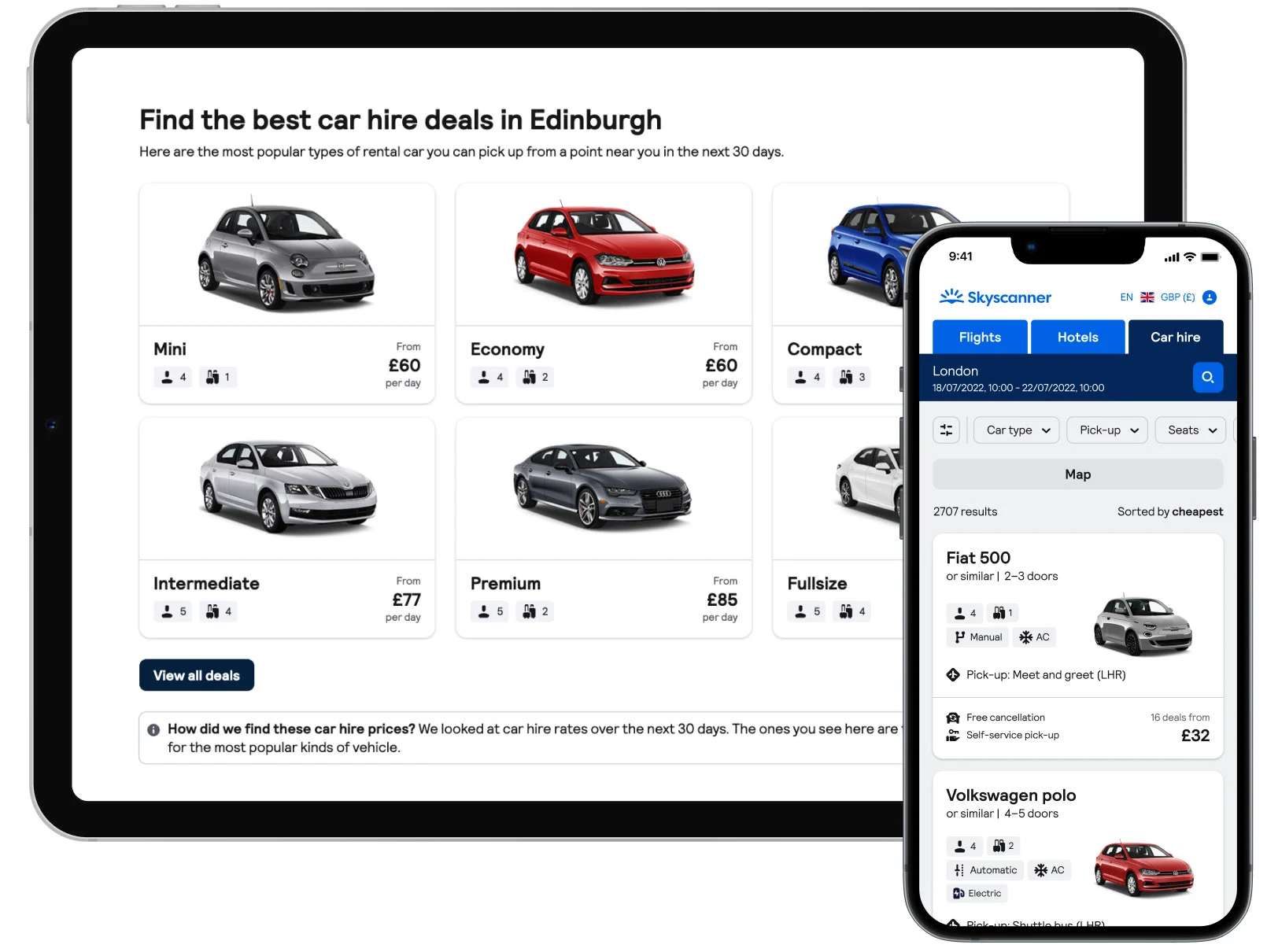
The reality is much more robust. Skyscanner applies the same algorithmic aggression to car rentals as it does to flights. It doesn’t just query the big names like Hertz, Avis, or Enterprise. It scrapes data from brokers, local dealerships, and budget aggregators to present a comprehensive view of the market.
For the road tripper, this transparency is vital. A rental giant might quote you $600 for a week-long SUV rental. A local agency, listed in the Skyscanner results, might offer the exact same class of vehicle for $400 because their depot is a shuttle bus ride away rather than curbside.
Skyscanner presents these options side-by-side. It democratizes the data. It allows you to make the choice: Is the convenience of walking to the car worth an extra $200? For a solo business traveler, maybe. For a family on a budget, probably not. Without the comparison tool, you wouldn’t even know you had the choice.
The Bundling Advantage: Exclusive Rates and Seamlessness
Here is the secret sauce that most travelers miss. We often assume that “bundling” is just a marketing term for “buying two things at once to save time.” We think of it as a convenience fee.
However, in the travel industry, bundling is often a key to unlocking opaque pricing. Rental car companies want your business, and they know that once you have booked a flight, you are a “qualified lead.” You are definitely going somewhere.
Because of this, bundling isn’t just for ease; Skyscanner often shows exclusive car hire rates when you search alongside your flight.
When you are logged in and browsing flights, the algorithms are working in the background. The car rental prices you see can sometimes be lower than if you were to search for the car in a standalone browser window. Why? Because the acquisition cost for the rental company is lower when they catch you in the flight flow. They are willing to shave off a margin to secure the booking right then and there.
Furthermore, bundling aligns your logistics. When you search for cars through your flight parameters, Skyscanner already knows your arrival time. It knows your terminal. It filters out the rental desks that will be closed when you land. It saves you from the horror story of landing in a new city only to find out you can’t pick up your keys until the next morning.
Navigating the Filters: A Guide for Families
If you are traveling solo with a backpack, you can rent a Fiat 500 and be happy. If you are traveling with a family of four, two suitcases per person, and a stroller, the “Economy” filter is a trap.
Skyscanner’s filtering system is essential for the family demographic. It allows you to filter not just by price, but by the metrics that actually matter to parents:
1. The “Fair Fuel Policy”
Nothing ruins the end of a vacation like a panic attack at a gas station three miles from the airport, trying to fill the tank to the precise “full” line to avoid a $9/gallon refueling charge. Skyscanner allows you to filter by Fuel Policy. You can specifically look for “Full to Full” (you pick it up full, you return it full) which is generally the most transparent and fair option. It filters out the “Pre-purchase” schemes that often result in you paying for fuel you didn’t use.+1
2. Car Type and Capacity
“Similar to a Ford Focus” is a dangerous phrase in the rental world. Does that mean it has a trunk, or a hatchback? Will the suitcase fit? Skyscanner breaks down vehicles by bag capacity and door count. For road trippers, this is non-negotiable. You can filter immediately for SUVs, People Carriers (Minivans), or Station Wagons. Seeing the bag capacity icon right next to the price prevents the “Tetris nightmare” at the airport curb.
Elevated travel starts with Skyscanner
3. Transmission Type
For our American readers traveling to Europe, this is critical. Manual transmission is the standard in many parts of the world and is significantly cheaper. If you cannot drive a stick shift, you must filter for “Automatic” immediately. Skyscanner makes this a primary filter, saving you from the awkward conversation at the rental desk in Italy where you have to admit you can’t drive the car you just paid for.
The “Hidden Costs” Detection System
One of the biggest complaints regarding car rentals is the “sticker shock.” You book a car for $20 a day, and by the time you leave the counter, it’s $60 a day.
While no third-party tool can control the upsell tactics of a desk agent, Skyscanner provides a layer of defense: User Ratings and Provider transparency.
Next to every car offer, there is a rating for the rental provider. These aren’t just star ratings; they are aggregates of user experiences regarding cleanliness, value for money, and, crucially, pickup efficiency.
If a rental company has a 2-star rating on Skyscanner, it is usually because they are notorious for hidden fees or aggressively pushing insurance. By sorting by “Top Rated” rather than just “Lowest Price,” you can often save yourself money in the long run. A slightly more expensive upfront cost from a reputable dealer often ends up cheaper than a “budget” dealer who charges you for every scratch and smudge.
A Scenario: The California Coast Road Trip
Let’s visualize this in practice. Imagine you are planning the classic Pacific Coast Highway drive with your family. You need to fly into San Francisco and fly out of Los Angeles (an “Open-jaw” ticket).
The Old Way:
- Search flights to SFO. Book them.
- Realize you need a one-way car rental.
- Go to a car rental site. Enter SFO pickup.
- Realize the “drop-off fee” for leaving the car in LA is $300.
- Panic and try to change your flights to a round trip.
- Pay change fees on the airline.
The Skyscanner Way: You enter your “Multi-city” flight search on Skyscanner. Once the flights are selected, you toggle over to the Car Hire tab. You input the same itinerary.
Skyscanner immediately scans for rental agencies that are friendly to one-way rentals. It highlights the total cost, often bundling the drop-off fee into the daily rate so you aren’t surprised. You spot a deal for a convertible Mustang (because it’s the PCH, after all) that is exclusively priced for travelers booking this specific flight corridor.
You check the “Pick-up” filter. You see that an off-airport rental agency is offering the car for 40% less than the airport counter. You check the “Shuttle” info provided in the listing, it’s a free 5-minute ride. You book it.
In one session, you have secured the flights and the car, you know the total cost of the transport, and you haven’t had to re-enter your credit card details four times.
Stop Fragmenting Your Travel
We live in an era of convenience, yet we often make travel planning harder than it needs to be by compartmentalizing every purchase. We buy flights here, hotels there, and cars somewhere else, convinced that we are “hacking” the system.
But the real hack is efficiency and visibility. It is seeing your entire trip costs in one view. It is leveraging the purchasing power of your flight booking to get a better deal on your wheels.
Next time you log on to check airfares, don’t stop at the confirmation screen. Click the tab next door. Explore the Car Hire options on Skyscanner. Compare the market. Look for that bundle deal.
Your wallet will thank you, but more importantly, your future self, standing at the arrivals curb, luggage in hand, knowing exactly where to go, will thank you.