This article contains affiliate links. If you purchase or book through these links, we may earn a commission at no additional cost to you.
In 2026, sustainability is no longer just a buzzword; it’s a status symbol.
The “flex” of the mid-2020s isn’t a brand-new, shrink-wrapped carbon frame bike. It’s a battered, well-loved piece of kit that has a story, and a second owner. With inflation still nipping at our heels and the “Right to Repair” legislation finally showing teeth in provinces like Quebec, the Canadian consumer has shifted. We want value, but we also want to feel good about where our gear ends up.
Enter Decathlon Canada’s “Second Life” program.
On paper, it sounds like the ultimate hack: you bring in your old, dusting-gathering sports gear, and they hand you a gift card to fund your next adventure. No Facebook Marketplace hagglers, no shipping scams. But does it work in the real world?
We decided to find out. We took a 3-year-old tent and a well-used hybrid bike to a local Decathlon workshop to see how much cash (well, credit) they’d actually give us, and whether the “Second Life” gear on the racks is worth buying with the proceeds.
The Experiment: The “Pile of Shame”
We raided the garage for two common items that typically end up in landfill or sold for pennies at garage sales:
- Item A: The “Festival Veteran”
- Product: Quechua 2-Seconds Pop-Up Tent (3-Person).
- Condition: Structurally sound, but visually tired. One muddy footprint near the door that wouldn’t scrub out, and a zipper that felt a little “sticky.”
- Original Price (approx): $160 CAD.
- Item B: The “Covid Commuter”
- Product: Riverside 500 Hybrid Bike.
- Condition: Ridden hard during the 2020 lockdowns, then ignored. Some surface rust on the chain, brake pads worn down, but the frame was scratch-free.
- Original Price (approx): $550 CAD.
Phase 1: The Digital Appraisal
Before hauling dirty gear to the store, we used Decathlon’s online estimation tool. This is the first filter. You enter the model, the year, and an honest assessment of the condition.
The Quote:
- Tent: The tool estimated between $40 and $60, provided there were no tears or mold.
- Bike: The estimate was a broader range: $180 to $230.
The Catch: The tool explicitly warns that “cleanliness matters.” If you bring in a bike covered in mud, they reserve the right to turn you away or deduct a cleaning fee from the value. We spent 20 minutes with a hose and a rag before heading out.
Phase 2: The In-Store “Interrogation”
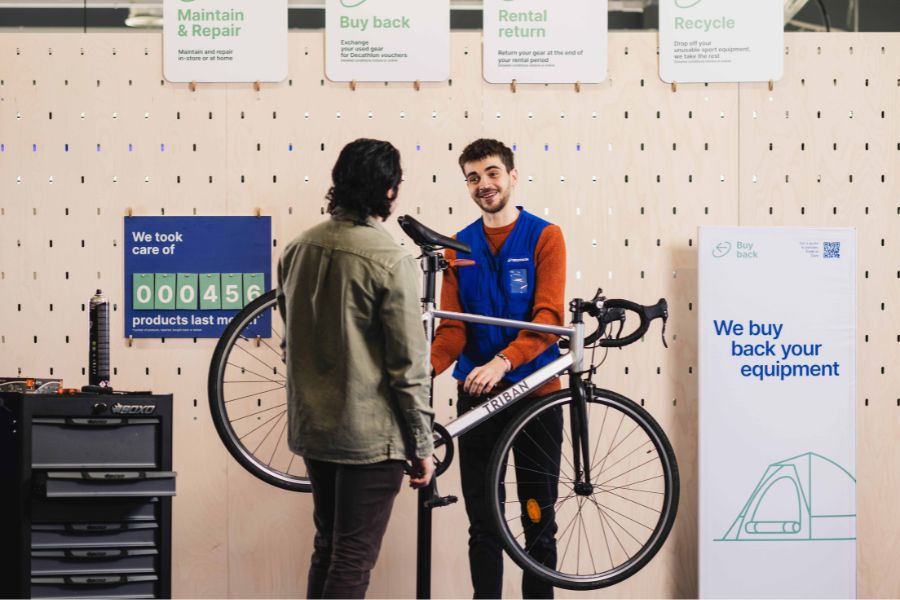
Walking into the store, we bypassed the shiny new aisles and headed straight to the “Atelier” (Workshop). This is where the rubber meets the road.
The technician, a serious-looking guy named Marc, didn’t just glance at the gear. He audited it.
The Tent Inspection: Marc popped the tent open right there on the concrete floor. He wasn’t looking at the mud stain; he was looking at the waterproofing tape on the seams and the fiberglass poles.
- Verdict: “The fabric is good, but the zipper is stiff. We have to replace the slider before we resell it.”
- Offer: $45. (Low end of the estimate, due to the zipper labor).
The Bike Inspection: This was more thorough. He checked the chain wear with a gauge, squeezed the brakes, and trued the wheels.
- Verdict: “Chain needs replacing, cassette is fine. Brake pads are dead. Frame is excellent.”
- Offer: $200. (Solidly in the middle of the estimate).
Total Haul: $245 in Decathlon Gift Cards.
Phase 3: The Re-Investment
Here is the friction point. If you want cash to pay your rent, this program is useless. You get a digital gift card, valid for 2 years. But for an outdoor enthusiast, this is basically “girl math” – free money.
We walked over to the “Second Life” aisle – a dedicated section of the store filled with refurbished returns and buy-backs.
The inventory is eclectic. We saw a high-end stand-up paddleboard (SUP) for 30% off because it had a cosmetic scratch, and a row of kids’ bikes that looked brand new.
With our $245 credit, we found a Refurbished Arpenaz Family Camping Tent (4.1 size).
- New Price: $300.
- Second Life Price: $220.
- Condition: It had been returned by a customer who “didn’t like the color.” It was effectively new, just unboxed.
We used the trade-in credit, paid nothing out of pocket, and still had $25 left over for a pack of dehydrated hiking meals.
The Verdict: Is It Worth It?
The answer depends entirely on how much you value your time versus your dollar.
The Pros:
- Zero Hassle: We didn’t have to take photos, write a description, or meet a stranger in a parking lot who might ghost us. The transaction took 20 minutes total.
- The “Eco-Guilt” Factor: Watching the technician tag our old bike for refurbishment felt surprisingly good. We knew it wasn’t going to a landfill.
- Instant Liquidity: We walked in with old gear and walked out with an upgrade immediately.
The Cons:
- The “Marketplace Gap”: Could we have sold the Riverside 500 bike on Kijiji or Marketplace for $300? Probably. We “lost” about $100 in potential value by trading it in for convenience.
- The “Golden Handcuffs”: The money is trapped in the Decathlon ecosystem.
Final Score: 8/10
For the busy parent or the gear junkie who is constantly upgrading, Decathlon’s Buy-Back program is a no-brainer in 2026. It removes the friction of selling and turns your garage clutter into immediate store credit.
However, if you are cash-poor and time-rich, you are still better off scrubbing that bike yourself and listing it on the open market. But for the rest of us? The Circular Economy just passed the test.