This article contains affiliate links. If you purchase or book through these links, we may earn a commission at no additional cost to you.
It is 2026, and we are tired.
If you are reading this, you have probably tried everything. You have strapped a $500 ring to your finger that shames you for having a glass of wine. You have worn a headband that hums at your temples. You have downloaded the “calm” apps, paid the monthly subscription, and listened to the sound of rain falling on a tin roof until you wanted to scream.
We are living in the Golden Age of Wellness Technology, yet we have never been more exhausted. The wellness industry has convinced us that sleep is a performance sport, a metric to be optimized, tracked, and hacked. We have a name for this now: orthosomnia, the anxiety caused by an obsession with perfecting our sleep data. We lie awake staring at the ceiling, terrified that our “Recovery Score” will be low tomorrow, which ironically ensures that it will be.
But there is a quiet revolution happening in an unexpected corner of the internet. While everyone else is pivoting to AI coaches and biometric sensors, MasterClass, the platform best known for teaching you how to cook like Gordon Ramsay or write like Neil Gaiman, has quietly assembled the most potent, science-backed mental health library in existence.
Forget the gadgets. Forget the monthly app subscriptions that bleed your wallet dry. For the price of a single therapy session, MasterClass offers a permanent solution to the 2026 burnout crisis. This is the Insomniac’s Guide to the platform, focusing exclusively on two titans who don’t just tell you to sleep, they rewire your brain to make it possible: Matthew Walker and Jon Kabat-Zinn.
Part I: The Sleep Diplomat (Matthew Walker)
If you have ever Googled “why am I tired,” you have likely stumbled upon Matthew Walker’s TED Talk or his bestseller Why We Sleep. But his MasterClass, “The Science of Better Sleep,” is something entirely different. It isn’t a lecture; it is an intervention.
Walker, a Professor of Neuroscience and Psychology at UC Berkeley, approaches sleep not as a nag, but as a “sleep diplomat”. In 2026, where misinformation about “polyphasic sleep” and “biohacking” runs rampant on social media, Walker’s course acts as a hard reset for your biological clock.
The Curriculum of Rest
The course is broken down into digestible lessons that dismantle the myths keeping you awake. It is visually stunning, filmed with the cinematic quality MasterClass is famous for, which strangely helps. You aren’t watching a grainy webcam video; you are watching a high-production documentary about your own biology.
1. The Caffeine Half-Life Reality Check One of the earliest and most shocking lessons for many students is the deep dive into caffeine. We all know coffee keeps us awake, but Walker explains the half-life of caffeine (about 5-7 hours). He visualizes how a “quarter-life” of caffeine still circulates in your system 12 hours later. If you have a cup at noon, a quarter of that caffeine is still fighting your brain at midnight. He doesn’t just say “stop drinking coffee”; he gives you the pharmacokinetic equation to drink it responsibly.
2. The Alcohol Lie In 2026, “wine mom” culture and “craft beer” hobbies are still huge. Walker dismantles the nightcap with brutal efficiency. He explains that alcohol doesn’t induce sleep; it induces sedation. You are just knocking out your cortex. He shows how alcohol fragments REM sleep, the stage responsible for emotional regulation. This lesson alone cures many people of their “2 a.m. anxiety wake-ups.” You realize you aren’t anxious; you are just processing the Pinot Noir.
3. The 25-Minute Rule This is the tactical nuclear weapon of the course. Walker explains that the worst thing you can do for insomnia is stay in bed. If you have been awake for 25 minutes, get up. Go to another room. Read a book. Only return when you are sleepy. He explains the Pavlovian conditioning of the brain: if you lie in bed awake, your brain learns that Bed = Awake. You have to break that association. It is terrifying to leave your warm bed at 3 a.m., but this single tip has a higher success rate than most sleeping pills.
4. Thermoregulation Walker dives into the physics of sleep, explaining that your core body temperature needs to drop by about 2-3 degrees Fahrenheit to initiate sleep. He prescribes a “hot bath hack”, not because heat makes you sleepy, but because the blood rushing to your skin surfaces dumps heat from your core, mechanically cooling you down like a radiator. It is biology, not magic.
Why It Beats a Tracker
A sleep tracker tells you that you slept poorly. It offers no solution. It is a rearview mirror. Walker’s MasterClass gives you the steering wheel. By understanding the why, the adenosine buildup, the circadian rhythm, the melatonin trigger, you stop feeling like a victim of your insomnia and start acting like the operator of your own machinery.
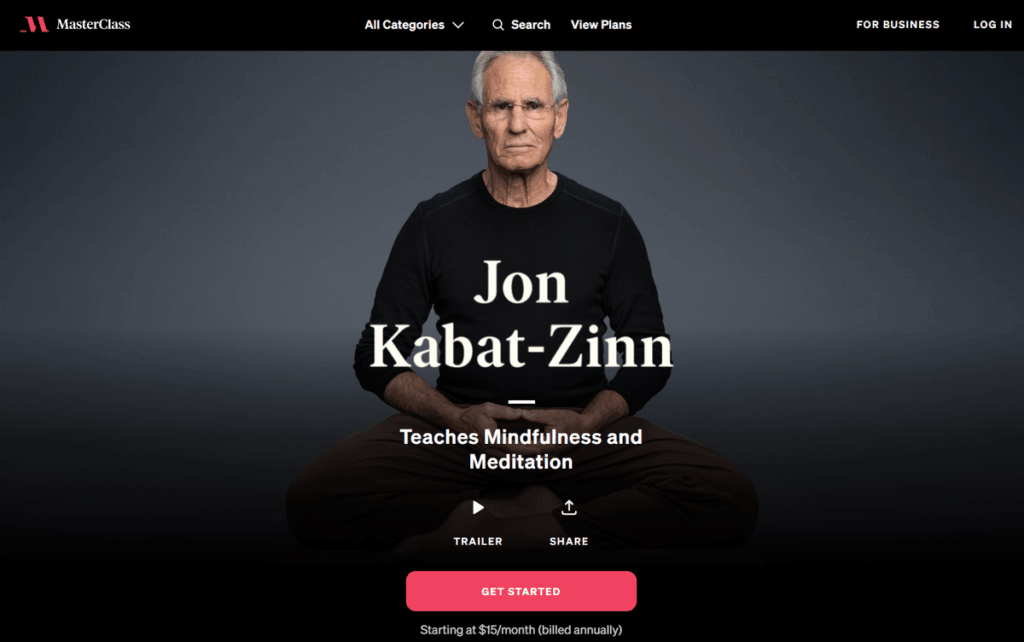
Part II: The Mindfulness Scientist (Jon Kabat-Zinn)
Once Matthew Walker has fixed your biology, you are left with the second problem: your mind. The body is tired, but the brain is running a marathon. Enter Jon Kabat-Zinn.
If you think “mindfulness” is just New Age fluff, you haven’t met Kabat-Zinn. He is a scientist, a molecular biologist by training who founded the Stress Reduction Clinic at the University of Massachusetts Medical School in 1979. He is the father of MBSR (Mindfulness-Based Stress Reduction), a clinical program used in hospitals worldwide to treat chronic pain and anxiety.
His MasterClass, “Mindfulness and Meditation,” is the antidote to the “McMindfulness” of 2026.
The Anti-Guru Approach
Most meditation apps today are gamified. They have streaks, badges, and cheerful voices telling you to “manifest abundance.” Kabat-Zinn’s course is starkly different. He sits in a chair, or lies on the floor, and talks to you like a weary but wise professor.
1. “Falling Awake” Kabat-Zinn reframes the entire concept of meditation. It isn’t about “zoning out” or “emptying your mind” (a common frustration for insomniacs). It is about “falling awake.” He teaches that trying to stop your thoughts is like trying to stop the ocean’s waves. You can’t. You can only learn to surf. This permission to have thoughts is revolutionary for the anxious sleeper.
2. The Body Scan This is the crown jewel of the course for insomniacs. The Body Scan is a 30-45 minute guided practice where you slowly move your attention through every inch of your body, from your left big toe to the top of your head. It sounds boring, and that is the point. It is a neurological down-shifting. By forcing your brain to focus on physical sensation, you disengage the “Default Mode Network”, the part of the brain that ruminates on your taxes, your ex, and your embarrassing moments from 2012. It is the most effective sleep aid on the platform, even though Kabat-Zinn insists the goal isn’t sleep (paradoxically, not trying to sleep helps you sleep).
3. The Mountain Meditation In a year as volatile as 2026, we all feel battered. Kabat-Zinn introduces “The Mountain Meditation”, a visualization where you embody the stability of a mountain. Seasons change, storms come, tourists litter, but the mountain just sits. It teaches emotional resilience. When you are lying in bed panicking about a presentation tomorrow, you assume the posture of the mountain. You observe the panic as just “weather” passing over the mountain. It doesn’t define you.
4. No “Right” Way Kabat-Zinn constantly reiterates that if you fall asleep during meditation, that’s fine. If your mind wanders 1,000 times, that’s fine, it just means you have 1,000 opportunities to bring it back. This removes the “performance anxiety” of meditation that apps often inadvertently create with their “perfect streak” counters.
Part III: The Synergy & The Economics
Why buy MasterClass for this? Why not just watch YouTube clips?
1. The Cohesive Ecosystem The magic happens when you pair these two courses. Matthew Walker gives you the hardware manual for your body. Jon Kabat-Zinn gives you the software update for your mind.
- Walker tells you to cool your room to 65°F and dim the lights to trigger melatonin.
- Kabat-Zinn gives you the mental discipline to lie in that dark room without freaking out.
- Walker tells you to get out of bed if you are anxious.
- Kabat-Zinn teaches you how to sit in a chair and do a breathing exercise until the “sleep pressure” returns.
They cover each other’s blind spots. Walker is pure science; Kabat-Zinn is pure experience. Together, they form a cognitive behavioral therapy for insomnia (CBT-I) program that would cost thousands of dollars in a clinic.
2. The Financial Logic of 2026 Let’s look at the math.
- Oura Ring / Whoop Band: ~$300 upfront + $6/month subscription. Total year one: ~$370.
- Therapy Apps (Calm/Headspace): ~$70/year.
- CBT-I Therapy: $150-$300 per session.
- MasterClass: ~$120-$180/year (often with 2-for-1 deals).
For less than half the price of a sleep tracker that only gives you bad news, you get lifetime access to the methodologies that actually fix the problem. Plus, once you are sleeping better, you still have the rest of the subscription to learn negotiation from Chris Voss or cooking from Thomas Keller.
The Verdict
In 2026, we don’t need more data. We have enough data. We know we are stressed. We know we aren’t sleeping. We don’t need a watch to vibrate and tell us our “Readiness Score” is low.
We need wisdom. We need to understand the machinery of our own bodies and the landscape of our own minds.
Matthew Walker and Jon Kabat-Zinn offer a return to basics. No batteries required. No bluetooth syncing issues. Just you, your breath, and the biological right to a good night’s rest.
If you are reading this at 3 a.m., put down the phone. Don’t download another app. Don’t buy another pillow. Sign up for the class, turn off the screen, and learn how to finally, truly, let go.