This article contains affiliate links. If you purchase or book through these links, we may earn a commission at no additional cost to you.
The foundational rules of search engine optimization are fracturing. For the past two decades, the goal of an SEO professional was clear: optimize for a blue link on a Google Search Engine Results Page (SERP). But we have officially entered the age of the Answer Engine, where users no longer want a list of websites to read, they want a definitive answer, curated instantly by a Large Language Model (LLM).
Traditional search is rapidly sharing its kingdom with conversational AI platforms like Perplexity, ChatGPT, and Claude. In this new landscape, the ultimate metric isn’t whether you rank position #1 on desktop; it’s whether an AI model pulls your data, synthesizes your perspective, and references your link inside its conversational output.
Recognizing this seismic shift, Semrush has dropped a massive infrastructure update. By launching its brand-new Model Context Protocol (MCP) Connector natively inside Perplexity AI, Semrush has bridged the gap between traditional enterprise SEO data and live AI workflows.
Explore Semrush’s Perplexity Integration
For advanced SEOs, tech-savvy marketers, and forward-thinking brands, this integration isn’t just a cool new feature. It changes the entire playbook for how data is consumed and how visibility is optimized across the shifting frontiers of generative AI.
The Technology: Decoding the MCP Connector in Perplexity
To understand why this launch is historic, we have to look past standard APIs and look at the underlying architecture. Semrush is utilizing the Model Context Protocol (MCP), an open-source standard designed to give LLMs secure, programmatic access to external data repositories.
Historically, if you wanted an AI tool to analyze your search data, you had to manually export giant CSV files from Semrush, upload them into a chat window, and hope the LLM’s context window didn’t hallucinate the metrics.
Semrush’s new MCP Connector completely collapses this friction. It embeds Semrush’s massive data layer, encompassing 28.4 billion keywords, 43 trillion backlinks, and hundreds of millions of domain profiles, directly into Perplexity’s conversational ecosystem (specifically utilizing Perplexity’s “Computer” feature and Comet browser integrations). Monitor your presence across AI platforms
How It Works in Real-Time
A user with a paid Perplexity account can navigate to their settings, activate the official Semrush connector, and instantly turn Perplexity into an advanced, AI-native SEO workbench. Instead of jumping between tabs, you can query live search intelligence using natural language prompts directly inside the chat interface:
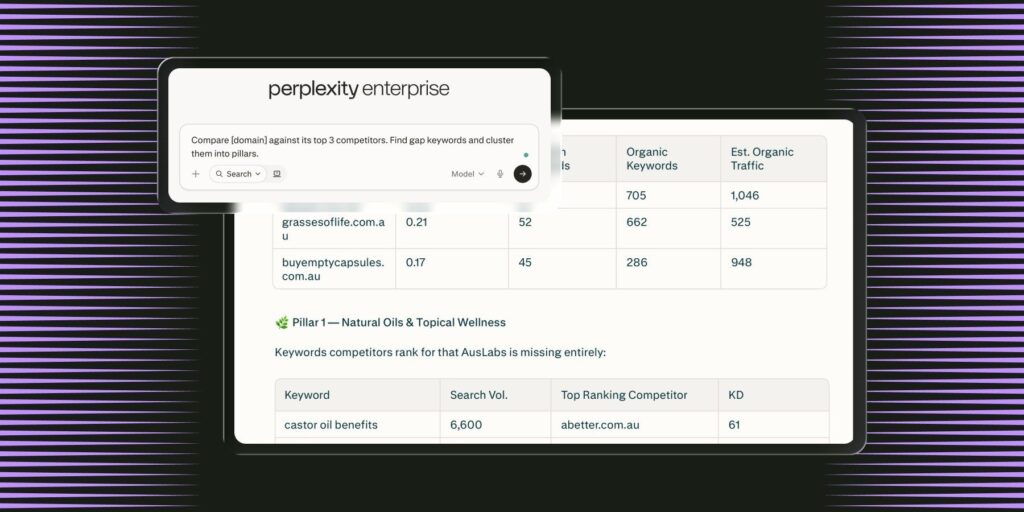
“@Semrush, analyze our main competitor’s domain for the last quarter. Identify their top 5 climbing keywords, cross-reference them with our current page-level gaps, and output a structured content optimization strategy.”
Perplexity doesn’t just scrape the live web; it pings the Semrush API through the MCP server, retrieves real-time keyword difficulty, share of voice, and traffic analytics, and parses that data into an immediate, strategic response. The workflow shifts from tedious data extraction to high-level strategic orchestration.
The New Frontier: Why “Generative Engine Optimization” (GEO) is the New SEO
We need to be blunt: if you are only tracking standard Google rankings, you are blind to a massive portion of your target market’s customer journey. Users are shifting informational intent queries away from traditional search bars and moving them into conversational interfaces. Future-proof your SEO strategy.
When a user asks Perplexity, “What is the best enterprise cybersecurity software for a remote engineering team?” they aren’t looking at ads or meta descriptions. They are looking at an LLM-synthesized narrative that explicitly mentions three or four brands and cites its sources via inline footnotes.
This has birthed a brand-new marketing discipline: Generative Engine Optimization (GEO).
| Traditional SEO | Generative Engine Optimization (GEO) |
| Keywords & Metadata | LLM Training Data |
| Backlink Quantity | Contextual Mentions |
| On-Page Formatting | Trusted Citations |
| Blue Link Rankings | AI Share of Voice |
In GEO, success is measured by your LLM footprint. If an AI engine doesn’t know your brand exists, or if it can’t crawl and trust your data, you simply do not exist to that user.
To win this battle, you need the right tools to monitor your standing. Advanced teams are using specialized dashboards to track your AI brand visibility, discovering exactly how often their products are cited across major LLMs and where competitors are quietly boxing them out of AI answers.
The Power of the Semrush AI Visibility Toolkit
The Perplexity MCP integration is beautifully complemented by Semrush’s standalone AI Visibility Toolkit. While the connector allows you to pull data into your AI research sessions, the toolkit gives you an analytical aerial view of how your brand is perceived across the entire AI ecosystem, tracking models like ChatGPT, Gemini, and Google AI Overviews.
Advanced marketers are focusing heavily on three core reports within this ecosystem to refine their GEO strategies:
1. The Visibility Overview and LLM Distribution
The toolkit provides a concrete AI Visibility Score scaled from 0 to 100. It tracks your overall footprint across distinct models, letting you see if your brand is heavily favored by ChatGPT but entirely ignored by Google AI Overviews. This distribution data helps you uncover algorithmic bias, allowing you to adjust your schema, robots.txt accessibility, or structural formatting depending on which model you need to capture.
2. Prompt Research: The New Keyword Research
Keywords are linear; prompts are multi-dimensional. In traditional SEO, you optimize for “best CRM.” In AI search, a user inputs a paragraph: “I run a boutique design agency with 12 remote workers and need a CRM that integrates with Notion and costs under $100 a month.”
The Prompt Research Report allows you to tap into Semrush’s database of over 261 million LLM prompts. It surfaces the exact situational questions, intent structures, and multi-turn queries users are inputting into conversational engines, allowing you to build hyper-targeted content assets that perfectly match those exact semantic profiles.
3. Brand Performance and Narrative Drivers
AI engines don’t just list you; they describe you. They assign sentiment and build narratives around your products. The Brand Performance report maps your Share of Voice (SoV) against brand sentiment. It analyzes whether the LLM views your software as “affordable but buggy” or “premium and reliable.” Identifying these narrative drivers gives you a direct roadmap for PR, case studies, and third-party review acquisition to reshape the qualitative data the LLM feeds on.
How to Optimize Your Infrastructure for AI Discovery
Possessing data through Semrush’s Perplexity integration is step one; acting on it is step two. If you want the MCP-connected LLMs and autonomous search bots to organically cite your site, your technical and editorial infrastructure must meet strict criteria.
Ensure Crawler Accessibility
Many brands accidentally shut the door on AI traffic by leaving archaic blocking rules in their infrastructure. You must audit your robots.txt files to ensure that search bots specifically tied to conversational search can parse your assets. Check for blocks against user-agents like OAI-SearchBot, GPTBot, and ClaudeBot. If your canonical tags are broken or your loading speeds are bogged down by heavy JavaScript execution, AI indexers will skip your content in favor of a faster, cleaner alternative.
Pivot to Sourced, Empirical Data
LLMs love data points, hard statistics, and verified methodologies. They are highly prone to citing content that features proprietary research because numbers provide concrete anchors for their synthesized responses.
Instead of writing vague editorial claims like “Our software vastly improves operational productivity,” update your content to state: “According to our 2026 Internal Q1 Case Study, our platform reduced engineering deployment friction by 22%.” This structural specificity makes your content highly extractable for an answering engine looking to back up its assertions with a reliable footnote.
The Strategic Shift: One Data Source, Infinite Perspectives
The true brilliance of Semrush’s shift into the Model Context Protocol space is the democratization of competitive intelligence. When you connect Semrush data natively into an AI assistant, you remove the silo between data analysts and the rest of the execution team.
- For SEO Directors: They can use Perplexity to instantly draft programmatic technical audit sheets, mapping structural issues against real-time ranking data without manual sorting.
- For Content Strategists: They can instantly feed live keyword gap data directly into an LLM to generate comprehensive content briefs that match the exact topical authority requirements of the current algorithmic landscape.
- For Executive Leadership: A CMO can query Perplexity for a top-level, conversational executive summary regarding a competitor’s market movement and AI share of voice shift, bypassing the need to wait for a manually built analytics report.
By moving search data out of isolated, rigid browser tabs and pushing it directly into the conversational ecosystem where modern thought workflows occur, Semrush has future-proofed its value proposition.
Adapt or Fade from the Matrix
The integration of Semrush’s data ecosystem into Perplexity via the MCP standard marks a definitive end to the old era of siloed search. We are no longer optimizing content for static algorithms; we are feeding dynamic, multi-model cognitive systems.
As consumers increasingly turn to conversational AI to make purchasing decisions, diagnose business inefficiencies, and discover products, the brands that rely strictly on legacy SEO monitoring will slowly fade from digital relevance.
The winners of this new era will be the teams that treat search intelligence as an ambient, AI-native input. By using tools to track your AI brand visibility, analyzing prompt intent, and using native conversational connectors to build real-time strategies, you ensure that when the next generation of buyers asks an AI for a recommendation, your brand is the answer it delivers.