
This article contains affiliate links. If you purchase or book through these links, we may earn a commission at no additional cost to you.
You wake up, pour your morning coffee, and open your analytics dashboard. Your heart sinks. Organic traffic is down 18% week-over-week. Revenue for your e-commerce store is sliding alongside it. Panic sets in. You haven’t changed your content strategy. You haven’t altered your backlink profile. You haven’t been hit by a manual Google penalty.
So, what happened?
Welcome to the era of the “invisible” ranking drop. In 2026, the most dangerous SEO threats aren’t algorithm updates or aggressive competitors; they are the silent, creeping technical errors buried deep within your website’s code. A broken internal link here, an accidental “noindex” tag there, a bloated javascript file, these micro-errors compound over time, creating a digital roadblock that stops search engine crawlers dead in their tracks.
The good news? You don’t need to spend weeks manually digging through source code to find the culprit. The solution takes less time than drinking your morning coffee. Here is how webmasters, technical SEOs, and e-commerce owners are using the Semrush Site Audit tool as a 12-minute health check to diagnose and fix invisible ranking drops.
The 2026 Reality: Why AI Search Engines Demand Technical Perfection
To understand why technical audits are non-negotiable today, we have to look at how search has evolved. In the early 2020s, traditional search engines were relatively forgiving. If your site was a bit slow or had a clunky architecture, Google might still index your incredibly well-written blog post and rank it based on backlinks and keyword relevance.
In 2026, the landscape is dominated by AI search agents. These systems operate differently. They need to rapidly ingest, synthesize, and cite information in milliseconds to generate real-time, conversational answers for users.
AI bots are notoriously impatient and strict. If an AI crawler hits your e-commerce product page and encounters a 3-second server response delay, it doesn’t wait around, it bounces to your competitor’s faster site. If your images are missing descriptive Alt Text, multimodal AI systems cannot accurately process what the image is, effectively erasing your visual assets from search results.
AI search engines prioritize clean, structured, and instantly accessible data. Poor crawlability means your content is practically invisible to the very systems that are dictating the future of organic traffic. If your site architecture is a tangled web of redirect loops and 404 errors, your brilliant content strategy is being wasted.
The Semrush Site Audit: Your 12-Minute Diagnostic Scan
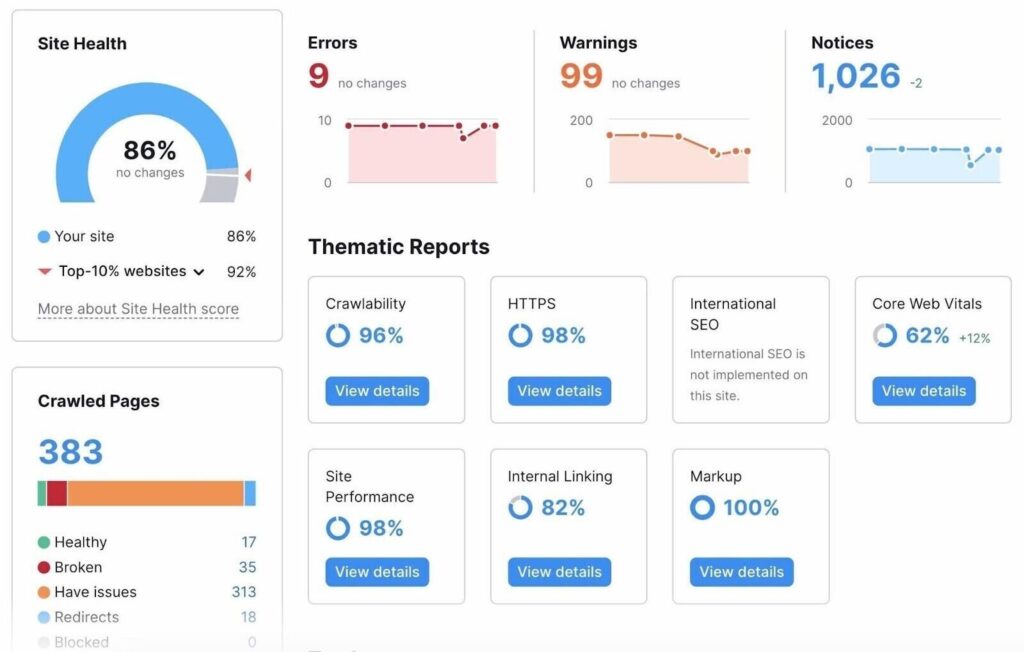
When you are bleeding traffic, you don’t have time to guess. You need immediate, actionable data. The Semrush Site Audit tool functions like an MRI for your website’s infrastructure. In a matter of minutes, it crawls your domain exactly the way a search engine bot would, analyzing your site against over 140 strict technical SEO checks.
Instead of presenting you with a confusing spreadsheet of raw data, Semrush processes these findings into an intuitive, prioritized dashboard. It breaks your website’s health down into three critical categories:
- Errors: Severe issues that are actively harming your rankings (e.g., broken internal links, 5xx server errors, duplicate title tags). These demand immediate attention.
- Warnings: Moderate issues that hinder optimal performance (e.g., low text-to-HTML ratio, missing alt attributes, missing H1 tags).
- Notices: Minor optimization opportunities that won’t ruin your site but are keeping you from achieving a perfect technical score (e.g., pages with only one incoming internal link, unnecessarily long URLs).
By running this audit, the “invisible” reasons behind your traffic drop are instantly dragged into the light.
The Top 5 “Silent Killers” the Audit Uncovers
When e-commerce owners and webmasters run their first Semrush Site Audit, they are often shocked by what they find. Here are the most common technical gremlins that destroy organic rankings in 2026:
1. The Crawlability Crisis (Accidental Blocks)
It sounds impossible, but highly experienced development teams frequently deploy staging code to a live site, accidentally leaving a Disallow: / directive in the robots.txt file, or a noindex tag on critical category pages. The Site Audit instantly flags these pages. If Google is told not to crawl your money pages, your traffic will flatline overnight.
2. The Redirect Loop Trap
E-commerce sites are constantly deleting out-of-stock products and redirecting those URLs. Over time, Page A redirects to Page B, which redirects to Page C, creating a chain. Search engine bots have a “crawl budget”, a limit to how much time they will spend on your site. Long redirect chains exhaust this budget, causing bots to leave before they index your new, profitable products. Semrush highlights exactly where these chains exist so you can break them.
3. Core Web Vitals and Load Speed
Speed is no longer just a ranking factor; it is a prerequisite for AI indexing. The Site Audit features a dedicated Site Performance report that highlights bloated Javascript, uncompressed images, and slow server response times. It doesn’t just tell you the site is slow; it tells you which specific file is causing the delay.
4. Missing Alt Text and Broken Images
As multimodal AI (text-and-image search) dominates the user experience, images are critical data nodes. If an e-commerce store has 5,000 product images with missing Alt Text, AI engines cannot “see” the products. Semrush’s media checks will flag every single missing attribute, allowing your content team to go in and provide the context AI engines desperately need.
5. Orphaned Pages
An orphaned page is a page that exists on your server but has zero internal links pointing to it. If a user cannot navigate to it, a bot cannot easily crawl it. This often happens with old blog posts or seasonal landing pages. The audit maps your entire internal linking structure, identifying pages that are floating adrift so you can integrate them back into your site architecture.
The Developer Handoff: Bridging the Gap Between SEO and Engineering
Identifying the technical errors is only half the battle; getting them fixed is where most companies fail. There is a traditional bottleneck in digital business: the SEO manager finds a hundred technical errors, dumps them into a massive, unreadable Excel file, and hands it to the development team. The developers, overwhelmed and lacking context, push the fixes to the bottom of the sprint backlog.
This is where the Semrush Pro tier entirely changes the game for operational efficiency in 2026.
Semrush understands that an audit is only as good as the workflow it supports. The platform features seamless, native integrations with task management systems like Trello and Zapier.
Instead of sending a massive spreadsheet to your engineering team, the Site Audit tool allows you to create specific, context-rich tasks directly from the dashboard. Found a 500 server error? Click a button to instantly send a formatted card to your developer’s Trello board. The card automatically includes the exact URL, the nature of the error, and Semrush’s recommendation on how to fix it.
This transforms technical SEO from a complaining department into a streamlined, collaborative machine. It bridges the communication gap, allowing technical SEOs to act as efficient product managers, ensuring that the critical errors blocking your AI search visibility are patched in the next development sprint.
The Free vs. Pro Dilemma: Why You Need to Scan 100,000 Pages
Semrush does offer a limited free audit for users who want to dip their toes into the water. If you run a five-page portfolio site, the free version might give you a decent overview. But let’s be entirely realistic: if you are an e-commerce store owner, a technical SEO, or a webmaster managing a digital asset that generates real revenue, the free version is merely a teaser.
Modern websites are massive. A standard e-commerce site with product variants, category filters, and a blog can easily eclipse 10,000 unique URLs. An invisible ranking drop usually isn’t hiding on the homepage; it’s buried in the pagination of a product category, or within a faceted navigation glitch that is dynamically generating thousands of duplicate URLs.
To truly diagnose a traffic hemorrhage, you need depth.
This is why activating the 14-day Semrush Pro Trial is the smartest 12 minutes you will spend today. The Pro tier unlocks the ability to scan up to 100,000 pages per month. It allows you to crawl deep into the subfolders of your architecture, run comprehensive JavaScript rendering checks, and unlock the vital Zapier/Trello integrations needed for the developer handoff.
You can configure the crawler to bypass specific parameters, check subdomains, and even schedule the audit to run automatically every Monday morning. By the time you sit down with your coffee, you have a fresh technical health score and a prioritized task list waiting for you. It is the ultimate insurance policy against invisible algorithmic drops.
Stop Guessing, Start Fixing
Organic traffic is the lifeblood of digital business. When it drops, the natural instinct is to panic, rewrite content, or aggressively build new links. But in 2026, throwing new content onto a technically flawed website is like pouring premium fuel into a car with a broken engine.
Before you change your marketing strategy, you must ensure your technical foundation is flawless. You must ensure that the AI bots and search engines can seamlessly crawl, read, and understand your data. You cannot fix what you cannot see, and right now, invisible technical errors might be costing you thousands of dollars in lost revenue.
Stop staring at downward-trending traffic graphs and wondering what went wrong. It is time to run the diagnostic with Semrush.