
This article contains affiliate links. If you purchase or book through these links, we may earn a commission at no additional cost to you.
There is a specific kind of frustration that only a precision-oriented professional understands: the “micro-wobble.” You’re in the middle of a deep-focus session, perhaps debugging a complex Salesforce workflow or analyzing a quarterly performance deck, and you shift your weight. Your monitors shiver. Your coffee ripples. In that moment, your desk isn’t a tool; it’s a liability.
In the world of home office setups, we often settle for “furniture.” We go to the local big-box store, pick out something that looks aesthetic in a catalog, and spend four hours squinting at pictograms to assemble a piece of particle board held together by hope and a few cam locks. But if you view your workspace as a high-performance environment, you shouldn’t be looking for furniture. You should be looking for engineering.
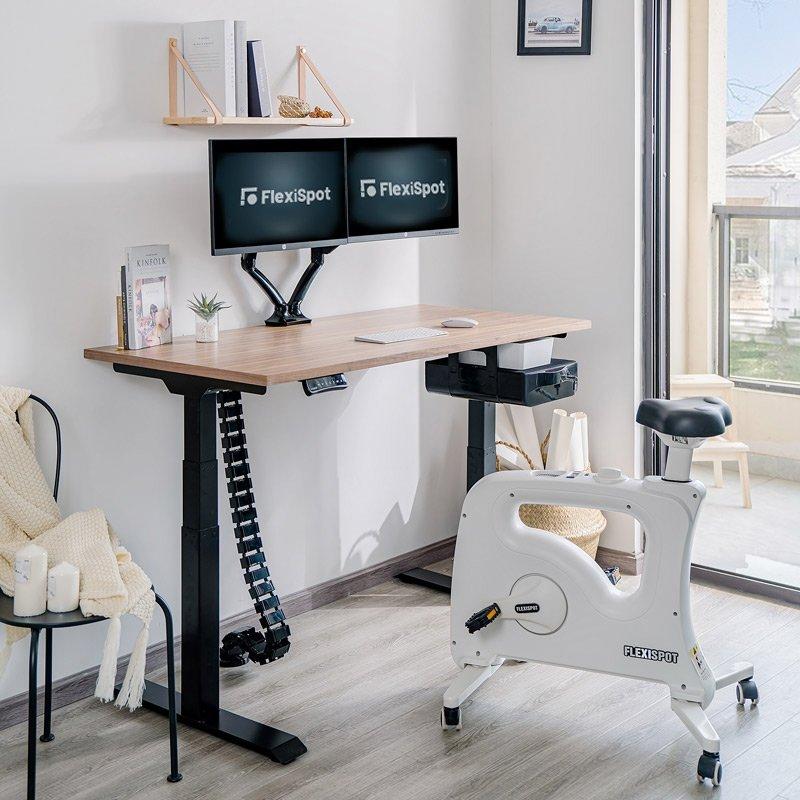
This is where the Flexispot E7 Series enters the conversation. By applying the principles of industrial-grade stability to the domestic workspace, Flexispot has created a standing desk that doesn’t just “go up and down”, it performs. For those who value torque, load-bearing capacity, and decibel-rated silence, the E7 isn’t an accessory; it’s a piece of German-standard machinery designed for the home.
The Structural Integrity of Carbon Steel
Traditional office furniture is designed for static loads. It’s meant to sit in one place, hold a few kilograms of paper, and look decent for three to five years. The moment you introduce movement, the mechanical lifting of a heavy workstation, the flaws in traditional construction become glaring.
The Flexispot E7 series is built on a foundation of automotive-grade carbon steel. While standard desks use thin-walled aluminum or, worse, composite wood legs, the E7 utilizes thickened leg columns that prioritize torsional rigidity.
Why does this matter? Because a standing desk is essentially a giant lever. When extended to its maximum height, any lack of precision in the leg fitment results in lateral sway. If you’ve ever tried to type on a cheap standing desk at 115cm, you know it feels like typing on a springboard. The E7’s frame is engineered to maintain a “rock-solid” stance even at its peak. It is the difference between driving a car with worn-out bushings and one with a sport-tuned, rigid chassis.
Dual-Motor Power: The Heart of the Machine
Most “budget” standing desks rely on a single motor and a hex-rod drive system to move the desktop. This creates a single point of failure and often results in an uneven lift if your equipment isn’t perfectly centered.
The E7 utilizes a dual-motor lifting system. Each leg houses its own dedicated power unit, synchronized by a central control box. This dual-motor configuration provides two critical advantages for the precision-oriented user:
- Consistent Torque: The E7 boasts a weight capacity of up to 125kg. To put that in perspective, that is roughly the weight of three ultra-wide monitors, a full-tower PC, a studio-grade microphone arm, and your heavy stack of reference books, with room to spare.
- Lifting Symmetry: Because the motors are managed by a sophisticated chipset, they adjust in real-time to ensure the desktop remains perfectly level, regardless of whether your heavy PC is on the left or your printer is on the right.
For a professional managing a “digital empire,” this reliability is non-negotiable. You aren’t just moving a piece of wood; you are moving thousands of dollars of sensitive electronics. You need a lift system that treats that cargo with the respect it deserves.
The “Quiet Apartment” Factor: Under 50dB
In the context of European living, specifically in shared German apartments (WGs) or historic Altbau buildings with thin walls, noise is a significant design constraint. Most motorized desks emit a high-pitched whine or a mechanical grind that can be heard through doors, making late-night productivity a recipe for a roommate dispute.
Flexispot has engineered the E7 motors to operate at a noise level of less than 50 decibels.
To put that into technical context: 50dB is roughly the sound of a quiet conversation or a low-humming refrigerator. The E7’s movement is a hushed, fluid whir. This allows you to transition from sitting to standing during a midnight coding session or an early morning strategy call without alerting everyone in a five-meter radius. It is a subtle flex of engineering, power that doesn’t need to shout to be felt.
Stability vs. The Standard Warranty
The most honest metric of a company’s engineering confidence is their warranty. Walk into a standard furniture store, and you’ll likely find a 1-year or 2-year limited warranty on office desks. They know that after 700 cycles of the lift mechanism, the cheap motors will begin to fatigue, or the MDF will begin to sag.
Flexispot offers a 10-year warranty on the E7 frame.
This isn’t just a marketing gimmick; it’s a lifecycle statement. They are betting that their carbon steel won’t fatigue and their dual-motor system won’t burn out over a decade of daily use. When you divide the cost of an E7 by a ten-year lifespan, the “expensive” engineering suddenly becomes the most economical choice on the market. You are buying the desk once, rather than replacing a wobbly alternative three times in the same decade.
Space Efficiency and the “Digital Empire”
Whether you are working from a dedicated home office in Agra or a compact studio in Berlin, floor space is at a premium. Traditional executive desks are “space hogs”, vast, heavy pieces of furniture that dominate a room.
The E7 series offers a telescopic frame that can be adjusted to fit a variety of desktop sizes. This modularity means the desk can grow (or shrink) with your career. Starting out in a corner with a 120cm top? The E7 fits. Moving into a larger suite and want a 180cm solid wood slab? The E7 frame expands to support it.
This adaptability is a hallmark of good engineering: the ability to serve multiple functions without compromising the core mechanical integrity.
Health as a Performance Metric
We often talk about ergonomic furniture in terms of “comfort,” but for the high-output professional, comfort is actually a proxy for stamina.
Back pain and neck strain are “performance throttles.” They pull your attention away from the task at hand and force you to end your workday early. By providing a seamless, stable transition between sitting and standing, the E7 keeps your blood flow optimized and your musculoskeletal system engaged.
When you stand at a desk that doesn’t wobble, you feel empowered to stay standing longer. You aren’t constantly fighting the furniture to keep your mouse steady or your webcam from shaking. The engineering fades into the background, leaving only your productivity.
The Verdict: Machinery Over Furniture
If you are the type of person who researches the sensor in your mouse, the switch type in your mechanical keyboard, or the Nits of brightness on your monitor, why would you settle for a desk that was designed with “good enough” as the goal?
The Flexispot E7 is a response to the “good enough” culture. It is a technical solution to a physical problem. From the anti-collision safety features, which use sensitive sensors to stop the desk if it hits an obstacle, to the cable management systems that hide the “spaghetti” of a modern tech setup, every inch of the E7 feels intentional.