This article contains affiliate links. If you purchase or book through these links, we may earn a commission at no additional cost to you.
For over two decades, the standard playbook for search engine optimization focused almost entirely on standard blue links: publish long blog posts, build backlinks from high-authority blogs, and optimize meta descriptions.
While traditional organic SEO still has its place, the rules for local businesses have drastically shifted. When someone searches for an emergency plumber, an artisan bakery, a boutique dental clinic, or a neighborhood marketing agency, they do not read 2,500-word informative essays. They look straight at the Google Map Pack (the top 3 local map listings featured prominently at the top of search results), check the star ratings, read the latest reviews, and tap Call or Get Directions.
If your business does not show up in those top three local map positions, you are practically invisible to your highest-intent, ready-to-buy neighbors.
To help independent business owners, multi-location brands, and digital agencies conquer the hyper-localized search landscape, Semrush built a dedicated solution: the Semrush Local SEO Toolkit.
This comprehensive guide breaks down how local search functions today, why traditional SEO methods fall short for neighborhood discoverability, and how to harness Semrush’s local toolkit to systematically climb to the top of Google Maps and maintain your position.
The Paradigm Shift: Why Traditional SEO Fails Local Businesses
Traditional SEO treats the internet as a borderless digital catalog where rank is dictated by domain authority, site architecture, and universal keyword difficulty.
Local SEO, by contrast, operates within physical space, proximity, real-time trust, and verified community reputation.
The Rise of “Zero-Click” Local Searches
The majority of local queries are now “zero-click” interactions. Potential customers find opening hours, direct phone numbers, customer photos, recent ratings, and parking availability directly inside Google Maps or Google Business Profile (GBP) knowledge panels without ever visiting your main website.
The Google Local Algorithm Triad
Google ranks local businesses based on three core pillars:
- Relevance: How well your business listing matches what the user is actively searching for (categories, service descriptions, menu items).
- Distance / Proximity: How close your physical business address or defined service area is to the searcher’s physical location or specified geographic query.
- Prominence: How established, reputable, and active your business appears across the web (citation consistency, review volume, recency, average star rating, and local backlinks).
If you are spending hours trying to build generic guest posts while ignoring duplicate address listings on Apple Maps, inconsistent phone numbers across online directories, or unanswered negative reviews, your Google Maps rank will stagnate.
The Semrush Local SEO Toolkit was engineered specifically to automate, track, and streamline the Prominence and Relevance factors of this formula.
Deep Dive: Key Modules Inside the Semrush Local SEO Toolkit
The Semrush Local SEO Toolkit is not just a basic add-on; it is a full-fledged local growth engine tailored for brick-and-mortar shops, mobile service providers, restaurants, and the marketing agencies managing them.
Let’s dissect its core components and how to put them to work for your business.
1. Listing Management (Automated Global & Local Citation Distribution)
Citations, mentions of your business Name, Address, and Phone number (often called NAP consistency), are fundamental trust signals for search engines. If Bing lists your address as “Suite 4B” while Yelp says “Ste 4” and TripAdvisor has an outdated telephone number, Google loses confidence in your business entity’s data integrity.
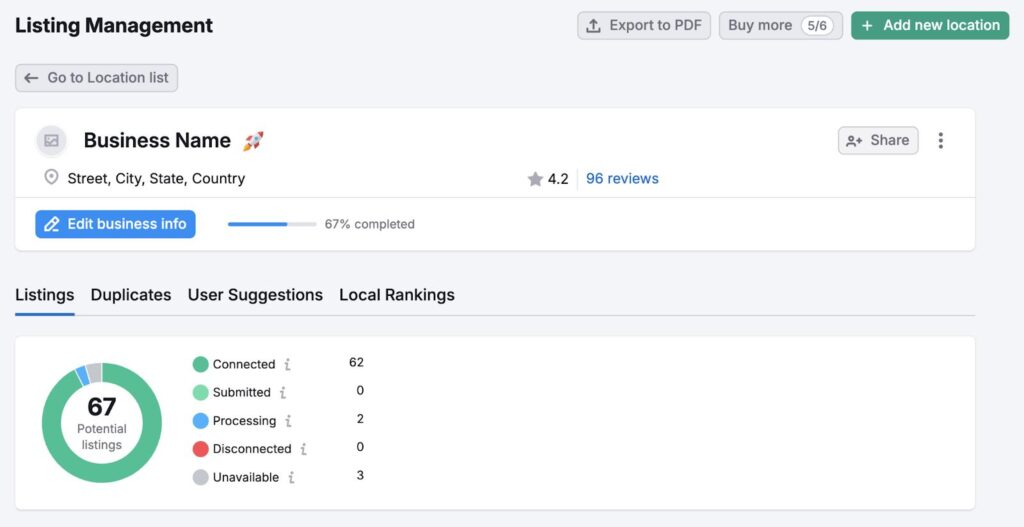
Fixing this manually across 70+ directories is tedious and prone to errors.
- Single-Dashboard Sync: Enter your core business details once, and Semrush distributes and locks your correct NAP data across top directories worldwide (Google, Apple Maps, Bing, Facebook, Yelp, TripAdvisor, Foursquare, TomTom, and localized yellow-page directories).
- Automatic Duplicate Suppression: Duplicate listings confuse search engines and dilute review equity. Semrush continually scans the web to find rogue, outdated, or accidental duplicate listings and suppresses or merges them automatically.
- Voice Search Optimization: The tool distributes your verified data to connected smart devices, ensuring Amazon Alexa, Siri, and Google Assistant pull your business when users make voice queries like “Find a florist near me.”
2. Map Rank Tracker (Hyper-Local Grid Tracking)
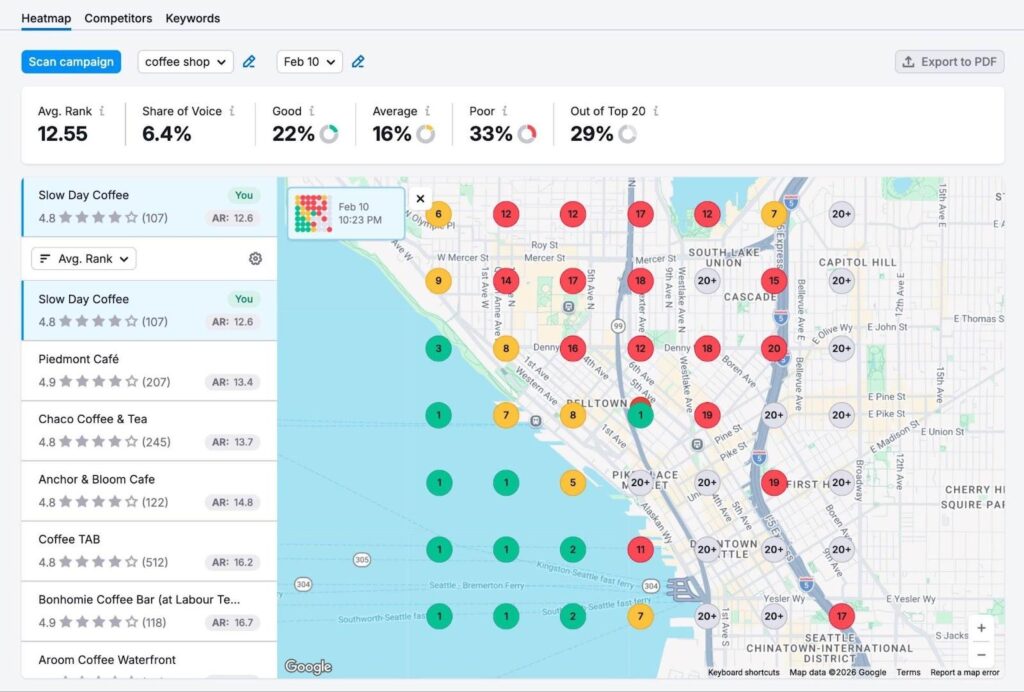
Traditional rank trackers report a single national or city-wide ranking (e.g., “You rank #3 for ‘Dentist in Manchester'”). In reality, local map rankings change block by block. You might rank #1 when someone searches right outside your clinic doors, but drop to #14 just three streets away.
- Interactive Heatmaps: Semrush’s Map Rank Tracker plots an interactive, visual grid over your target neighborhood or service area.
- Micro-Location Precision: It shows your exact ranking (from #1 to #20+) across specific geographic coordinates, helping you identify geographical dead zones where your competitors outperform you.
- Keyword Heatmap Tracking: Track high-value local queries simultaneously (e.g., “sourdough pizza,” “woodfired pizza delivery,” “late night pizza”) across your custom grid.
3. Review Management (Reputation & Sentiment Control)
Reviews are no longer just social proof; they are a direct algorithmic ranking factor. Search engines analyze review frequency, keyword mentions inside customer feedback, and how quickly business owners respond.
- Unified Inbox: Monitor and reply to incoming Google, Facebook, and directory reviews directly from a single Semrush dashboard without logging into multiple platforms daily.
- Smart AI Response Suggestions: Generate context-aware, polite, and personalized review replies with built-in AI assistance, ensuring you maintain a 100% response rate without burning hours of time.
- Review Generation Campaigns: Set up automated SMS and email campaigns urging happy, verified customers to leave authentic reviews directly on your Google Business Profile.
- Negative Feedback Alerts: Receive immediate notifications when a low-star review hits so you can resolve the customer’s complaint before it damages your reputation.
4. Google Business Profile (GBP) Optimization & Posting
Your Google Business Profile is your digital storefront. Treating it as a static business card is a recipe for losing local market share.
- Direct GBP Posting: Schedule regular updates, seasonal discounts, menu highlights, and company announcements directly through Semrush.
- Q&A Monitoring: Monitor the public Questions & Answers section of your GBP to preemptively answer community inquiries and prevent competitors or malicious users from posting inaccurate information.
- Photo & Media Updates: Consistently upload new, geotagged visuals to your profile, a habit correlated with higher click-through and direction-request rates.
Practical Action Plan: Dominating Google Maps Step-by-Step
To turn these toolkit features into tangible foot traffic, phone inquiries, and local sales, follow this battle-tested implementation framework.
Step 1: Run a Comprehensive Local Audit
Begin by plugging your business name and primary telephone number into the Semrush Listing Management tool. Identify missing directories, conflicting phone numbers, old physical addresses, and duplicate listings that are currently dividing your authority.
Step 2: Push Consistent NAP Data Everywhere
Update and lock your business information across all connected platforms. Ensure your Primary Business Category is exact (e.g., choosing “Italian Restaurant” over a broad “Restaurant” category makes an immediate difference in niche discovery).
Step 3: Establish a Grid Baseline with Map Rank Tracker
Set up a $5\times5$ or $7\times7$ coordinate grid around your physical storefront using your top three commercial keywords. Take note of which neighborhoods show strong green rankings (#1-#3) and which show red zones (#8+).
Step 4: Launch a Systematic Review Engine
Set a goal to generate a consistent stream of new reviews every week rather than a sudden spike once a year. Instruct your team to invite customers to review specific products or services (e.g., “If you enjoyed our deep-dish vegan pizza, mention it in your review!”). These natural keywords inside customer reviews strengthen your profile’s topical relevance.
Step 5: Maintain Weekly Profile Activity
Use the Semrush dashboard to publish at least one GBP post per week, upload fresh photos, and respond to every single review within 24 to 48 hours. Consistent activity signals to search engines that your business is open, thriving, and engaged with its local community.
Strategic Comparison: Traditional SEO vs. Semrush Local SEO
To see where to invest your marketing energy and budget, consider how traditional organic optimization stacks up against dedicated local optimization:
| Strategic Dimension | Traditional Organic SEO | Semrush Local SEO Toolkit |
| Primary Goal | High rankings on global search engine results pages (SERPs) | Dominating the Google Map Pack (Top 3 map spots) |
| Key Assets | Long-form blog content, backlinks, technical site structure | Google Business Profile, local directories, active reviews |
| Target Audience | Broad information seekers worldwide | High-intent, local consumers ready to visit or call |
| Tracking Method | Universal organic keyword rank tracking | Hyper-local geo-grid map rank tracking by street/block |
| Conversion Focus | Form fills, email newsletters, digital downloads | Phone calls, foot traffic directions, booking reservations |
| Primary Metric | Domain Authority & organic traffic volume | Local pack share of voice & local conversion actions |
Who Benefits Most from the Semrush Local Toolkit?
- Service Area Businesses (SABs): Plumbers, electricians, roofers, landscapers, and cleaners who travel to clients rely heavily on localized prominence within specific postal codes.
- Brick-and-Mortar Retail & Hospitality: Cafes, bakeries, clothing boutiques, bars, and specialty stores that depend on daily foot traffic and nearby directional searches.
- Healthcare & Professional Services: Dentists, chiropractors, law firms, accountants, and veterinary clinics where local proximity and review trust dictate client choice.
- Digital Marketing Agencies: Agencies managing dozens of local clients can streamline reporting, white-label local audit results, and manage hundreds of location listings from a single multi-location dashboard.
Fun & Frequently Asked Questions (FAQs)
1. Does having a physical storefront guarantee a #1 rank on Google Maps?
Not at all. While physical proximity is one of Google’s strongest ranking signals, a competitor three blocks farther away can easily outrank you if they possess cleaner directory citations, significantly more high-rating reviews, an active GBP posting schedule, and complete profile category details.
2. Can I use the Semrush Local Toolkit if I run a business from home without a public storefront?
Yes! If you run a Service Area Business (like mobile car detailing or home tutoring), you can configure your Google Business Profile to hide your physical residential address and instead display your specific service zones. Semrush manages and monitors these service-area profiles smoothly.
3. Why are my Google Maps rankings different when I walk down the street?
Google calculates proximity dynamically based on the exact GPS coordinates of the searcher’s smartphone or Wi-Fi router. As you walk away from your storefront, your proximity score decreases, which is why Semrush’s Map Rank Tracker uses a coordinate grid to show you realistic ranking variations across town.
4. Will getting 50 reviews in one day shoot me to the top of Google Maps?
A sudden, unnatural spike in review volume can trigger Google’s automated spam filters, leading to filtered or deleted reviews. Google prefers review velocity, a steady, authentic cadence of 2 to 5 new reviews every week alongside thoughtful merchant responses.
5. Can I just do all this directory listing manually for free?
You can manually claim listings on major platforms one by one, but maintaining them is an operational headache. If you change opening hours for holidays, move locations, or launch a new phone line, you would have to log into dozens of independent platforms to update them. Semrush syncs all changes instantly from a single window.