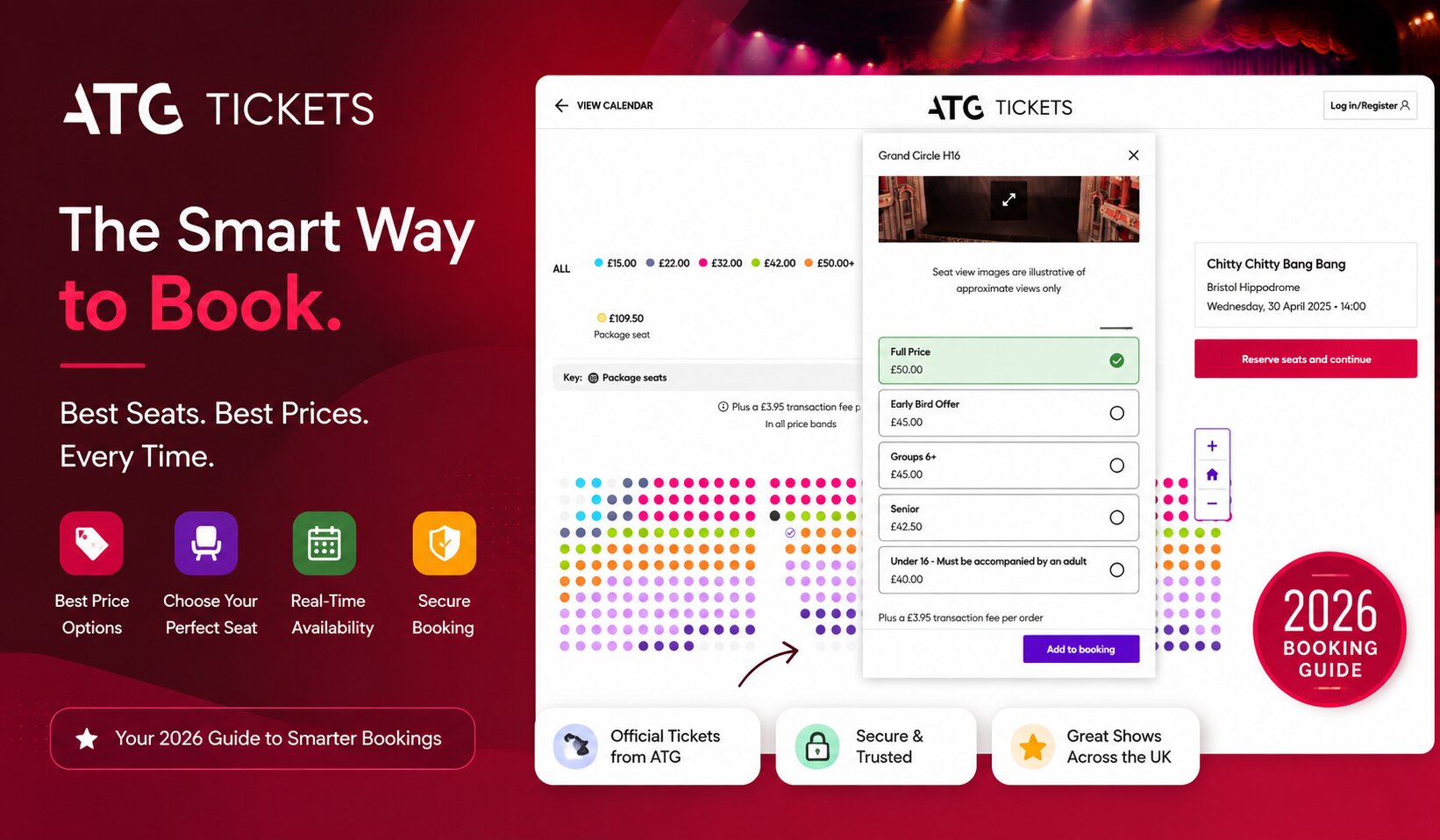
There is few feelings quite like the house lights dimming in a historic West End venue or a bustling regional theatre. But nothing kills that pre-show excitement faster than reaching the checkout page on ATG Tickets and discovering that four seats in the back row will cost you half a month’s rent.
As the UK’s largest theatre operator, Ambassador Theatre Group (ATG) manages dozens of iconic venues, from London’s Lyceum and Apollo Victoria to regional powerhouses in Manchester, Edinburgh, Bristol, and Birmingham. With millions of tickets sold each year, ATG relies on sophisticated dynamic pricing algorithms. That means ticket costs fluctuate wildly based on demand, day of the week, seating band, and how quickly seats are filling up.
If you know how the system operates, you can secure pristine sightlines at a fraction of the standard price. This insider guide breaks down the exact seat-selection and booking strategies you need to master ATG Tickets in 2026.
How ATG Ticket Pricing Works
To beat the system, you first have to understand how ATG calculates the number on your screen. Gone are the days when a seat in the Stalls cost a fixed £50 regardless of when you bought it.
ATG employs dynamic pricing. When a show is first announced, tickets are released across standard price tiers (typically Band A down to Band E, plus Premium). As momentum builds and seats in a specific band sell out, ATG’s automated system raises the price of the remaining seats in that category, or re-tiers seats into higher price bands altogether.
When you look at your final total, your ticket price consists of three distinct components:
- Face Value (Base Ticket Price): The core cost set by the show’s producers and ATG.
- Restoration Levy: A small, mandatory charge (usually £1.50-£3.00 per ticket) that goes directly toward preserving and maintaining heritage theatre buildings.
- Per-Ticket Booking Fee & Per-Order Transaction Fee: Charges that cover digital ticketing infrastructure, box office technology, and payment processing.
Because these fees can add £3 to £10+ per ticket, understanding how to minimize or eliminate them is key to stretching your entertainment budget.
Best Seats vs. Cheapest Seats: Decoding the Floor Plan
Every ATG seating map looks like a colorful mosaic, but price tiers don’t always reflect viewing quality. Knowing the geometry of older auditoriums helps you spot hidden bargains.
THE STAGE
↓
STALLS – Eye-level, immersive views; watch for overhangs
↓
ROYAL / DRESS CIRCLE – Premium sightlines and greater depth
↓
GRAND / UPPER CIRCLE – Steeper incline with great value
↓
BALCONY / GALLERY – Budget-friendly seats with higher elevation
1. Stalls (Ground Level)
- The Vibe: Immersive, close to the actors, and energetic.
- The Trap: The Circle Overhang. Rows toward the back of the Stalls (often Row R and further back) sit underneath the overhang of the Royal/Dress Circle. While you won’t miss action at stage level, you may lose the top third of high-production sets (like flying props or multi-tier sets in musicals like Wicked or The Lion King).
- The Bargain: Look for seats just under the overhang line that ATG has downgraded to Band C or D. If the production is ground-focused, these offer premium proximity at budget prices.
2. Royal Circle / Dress Circle (First Tier)
- The Vibe: Widely considered the best overall view in any West End or touring venue.
- The Trap: Front-row seats often come with a safety rail that cuts directly through the sightline of shorter audience members or children.
- The Bargain: Rows 3 through 5 in the central block offer perfect elevation, zero overhang issues, and full stage visibility, frequently priced just below “Premium.”
3. Grand / Upper Circle (Second Tier)
- The Vibe: Panoramic views from a higher angle.
- The Trap: Rake steepness. Older theatres (like the Lyceum or Manchester Palace) have steep incline steps that can cause vertigo or feel cramped for tall audience members.
- The Bargain: The front two rows of the Grand Circle frequently cost 40% less than the back row of the Dress Circle, yet offer an unobstructed, centered view of the entire set layout.
4. Restricted View & Pillar Seats
Don’t be automatically scared off by the “Restricted View” warning.
- Pillars: Victorians loved support columns. If a seat is marked “Restricted View: Pillar,” check whether the pillar is directly in front of your head or off to the side. An off-center pillar that blocks 5% of the far stage-left corner might come with a 60% price discount.
- Side Boxes: Boxes offer royal elegance and legroom, but side angles mean you will lose action on the immediate side wall near your box.

How to Compare Different Performances Before Booking
One of ATG’s most critical quirks is that discounts and seat tiers vary significantly from one performance to the next. Booking blindly on a default date almost guarantees overpaying.
Here is how to run an effective performance comparison on the ATG platform:
- Toggle the Interactive Calendar: When selecting dates, avoid picking a single day immediately. Open the full monthly view. ATG highlights dates with starting prices (e.g., “From £13”).
- Compare Parallel Seat Maps: Open two browser tabs side-by-side, one for a Friday evening and one for a Tuesday evening. Click the exact same seat row (e.g., Dress Circle, Row D, Seat 14). You will often discover that the exact same piece of velvet costs £95 on Friday but drops to £55 on Tuesday.
- Cross-Check Regional Tour Venues: If you live in the Midlands or North West, check neighboring ATG venues. A touring production visiting the Liverpool Empire might have lower overall baseline pricing than the exact same tour stopping at the Manchester Opera House or Bristol Hippodrome.
How to Find Cheaper Performances
If your schedule is flexible, finding cheap tickets isn’t about luck; it’s about timing.
- Preview Performances: When a major show or new cast debuts, the first 1–2 weeks of shows are categorized as “Previews.” Producers use these to fine-tune lighting, pacing, and sound. Previews are priced up to 30% lower than post-press night performances, even though you get 99% of the finished spectacle.
- End-of-Run vs. Launch Weeks: The second week of a multi-week regional run is typically the cheapest. Launch week generates buzz, and the final week triggers FOMO (Fear Of Missing Out), driving dynamic algorithms upward.
- Post-Holiday Lulls: The weeks immediately following Christmas/New Year (late January through mid-February) and the final week of September see sharp dips in overall theatre attendance. ATG often runs flash promotions during these windows to fill seats.
Weekday vs. Weekend Tickets
The “Weekend Tax” is very real in the theatre industry.
| Performance Window | Demand Level | Average Price Index | Seat Availability |
| Mon – Wed Evening | Low to Moderate | Base Price (£) | High |
| Thursday Evening | Moderate | Base + 10-15% | Moderate |
| Friday Evening | High | Base + 25-35% | Low |
| Saturday (All Day) | Peak | Base + 40-50% | Very Low |
| Sunday (Where Applicable) | High | Base + 30% | Low |
If you want the best seat for your money, Tuesday and Wednesday evenings are the golden hours. Producers lower the dynamic pricing threshold on midweek nights, meaning seats that were categorized as “Premium” on Saturday morning drop into “Band A” or “Band B” pricing mid-week.
Matinee vs. Evening Performances
There is a common myth that matinees are always cheaper than evening performances. On ATG, that depends heavily on the day:
- Midweek Matinees (Wednesday/Thursday): These are genuinely the cheapest tickets available. They are heavily patronized by retirees, tour groups, and flexible schedules. Prices are often 20-40% lower than evening slots.
- Saturday Matinees: These are not budget performances. Saturday matinees operate at peak weekend pricing because families and out-of-town day-trippers compete aggressively for these slots.
Note on Casting: While lead stars almost always perform in matinees, double-show days (like Wednesdays and Saturdays) carry a slightly higher likelihood of alternate performers or understudies taking the stage for demanding vocal roles. If seeing a specific celebrity lead is your top priority, check show schedules carefully.
Family and Concession Tickets
You should never pay full price if you fit into a recognized concession category. ATG offers structured discount programs across its venues:
1. Local Heroes Discount
ATG runs a dedicated Local Heroes scheme offering up to 25% off tickets for essential community workers. Eligible professions generally include:
- NHS staff & Healthcare workers
- Teachers and Education staff
- Police, Fire, and Emergency Services
- Serving Armed Forces and Veterans
- Social Care personnel
To claim this, select the “Local Heroes” rate during checkout or filter by concession rates, and ensure you bring valid professional ID to the box office.
2. Under 26s, Students, and Seniors
- Students & Under 26: Select shows offer standby or advance ticket deals starting as low as £15-£20 for younger audiences.
- Seniors (60+): Senior concessions are primarily attached to midweek matinee performances rather than weekend evening shows.
3. Family Ticket Packages
For family-centric musicals, pantomimes, and seasonal shows, ATG frequently offers family bundles (e.g., 4 tickets for the price of 3, or kids go half-price with a paying adult on select midweek dates).
ATG+ Membership: Is It Worth It?
ATG operates a paid membership tier called ATG+. In 2026, the membership costs around £35-£50 per year (depending on active promotional join rates), but for regular theatregoers, it quickly pays for itself.
ATG+ Membership Perks
✓ No Transaction or Booking Fees on most shows
✓ Up to 50% Off opening-night tickets for regional tours
✓ Priority Booking Windows – secure seats before general release
✓ Free Ticket Exchanges up to 48 hours before the show
✓ 25% Off Bar Drinks & Refreshments at ATG venues
The ATG+ Math: When Does It Break Even?
- Fee Savings: A typical ATG transaction fee is around £3.95 per order, plus per-ticket booking fees. If you book 4 times a year, you save ~£15-£25 purely on waived fees.
- Opening Night Discounts: ATG+ members get massive discounts on opening nights of regional touring shows, often £10 off per ticket or 50% off across Bands A–C.
- Bar Savings: With 25% off venue bars, a couple buying two drinks per visit will save £4–£6 every time they attend a show.
Verdict: If you buy more than 4 tickets a year across ATG venues, an ATG+ membership is practically free money. If you only see one West End show annually, skip it.
How Far Ahead to Book
Timing your purchase is a balancing act between seat choice and price optimization.
BEST TIME TO BOOK
West End Blockbusters → 3-6 Months Ahead
Early-bird booking for the biggest productions
Regional Musicals & Tours → 1-2 Months Ahead
Or book around opening night on ATG
Plays & Stand-Up Comedy → 2-4 Weeks Ahead
Watch for late availability and price drops
- West End Megahits (Wicked, Lion King, Cabaret): Book as early as humanly possible (3-6 months ahead). Dynamic pricing aggressively raises prices on these shows as the performance date approaches. Last-minute bargains rarely exist for flagship hits.
- Regional Touring Shows: Book during the ATG+ Priority Window if you are a member to grab opening-night half-price deals. Otherwise, aim for 4-6 weeks prior.
- Off-Peak Plays & Midweek Comedy: Wait until 1-2 weeks out. If sales are sluggish, producers frequently downgrade unsold central Stalls seats to Band B or C to fill the auditorium.
What to Check Before Paying
Before entering your credit card details, perform this 30-second audit:
- Verify Sightline Warnings: Check for notes like “Side View,” “Safety Rail in Sightline,” or “Restricted Legroom.”
- Review the Fee Summary: Ensure you aren’t paying optional add-ons you don’t need, such as physical ticket delivery (eTickets sent to your smartphone are free) or unwanted ticket protection insurance if your credit card already covers cancellations.
- Log Into Your Account First: If you are an ATG+ member or have stored concession credentials, ensure you are logged in before putting seats in your basket, as member discounts don’t always apply retroactively at checkout.
How to Avoid Paying More Than Necessary: The Strategy Checklist
Print or screenshot this quick-reference checklist before booking your next show:
- [ ] Aim for Tuesday or Wednesday evenings to dodge the weekend surcharge.
- [ ] Compare surrounding dates using ATG’s monthly calendar toggle before picking a show.
- [ ] Target the front rows of the Grand Circle or mid-Stalls behind the overhang line for maximum value.
- [ ] Use Local Heroes or Concession discounts if eligible (NHS, student, senior, military).
- [ ] Join ATG+ if you plan on booking 2+ trips or 4+ tickets this year to wipe out booking fees.
- [ ] Opt for eTickets to avoid physical postage costs.
Frequently Asked Questions (FAQs)
Can I upgrade my seats at the theatre if there are empty ones?
Official ATG policy requires you to sit in the seat assigned to your ticket. However, if the house is noticeably quiet after the curtain goes up, you can politely ask an usher during the interval if you may shift to open seats in your same tier. Never attempt to jump tiers (e.g., moving from Upper Circle to Stalls) without box office approval!
What happens if a pillar blocks more of my view than advertised?
If you arrive at your seat and discover an unadvertised structural obstruction that severely hampers your view, approach a head usher or the front-of-house manager before the show starts or during the first 10 minutes. If alternative seats are available, house managers are usually happy to reseat you.
Are Dress Circle seats actually reserved for royalty?
Historically, the “Royal Circle” or “Dress Circle” was where wealthy patrons sat in formal evening dress to be seen by the rest of the auditorium. While you no longer need a tuxedo or ballgown to sit there, it remains the premier tier for balanced acoustics and sweeping visuals.
What is the “Restoration Levy” on my ticket?
The Restoration Levy is a mandatory charge (typically £1.50-£3.00) that goes into a dedicated fund to maintain, repair, and restore historical theatre architecture. Since many ATG venues are Grade I or Grade II listed buildings dating back to the Victorian and Edwardian eras, this fee keeps the plasterwork, seating, and gold leaf looking pristine!
Does ATG offer rush tickets or day seats?
Yes! Select West End and major touring shows partner with platforms like TodayTix or offer online “Day Seats” directly through ATG at 10:00 AM on the morning of the performance. These tickets are heavily discounted (often £25 or less) for front-row or side-view seats.