This article contains affiliate links. If you purchase or book through these links, we may earn a commission at no additional cost to you.
Search visibility is no longer played out exclusively on traditional search engine results pages. While ranking on Google’s organic blue links remains critical, digital discovery has fractured across generative AI answer engines, including ChatGPT, Google AI Overviews, Perplexity, and Gemini. A brand ranking on page one of standard search might find itself completely excluded from the AI summaries that capture zero-click searches.
To address this shift, Semrush restructured its platform offering by introducing Semrush One. Unlike standard tiered comparisons (such as Pro versus Guru), the real architectural decision facing marketers is between Semrush One, which bundles core SEO with native AI Visibility tracking, and a modular, individual toolkit approach (combining standalone SEO Classic plans with targeted add-ons like Local, Content, or standalone AI modules).
Is upgrading to the unified Semrush One plan worth the premium, or should you build a tailored stack with individual toolkits? Here is how both models compare across features, costs, and distinct user profiles.
What Is Semrush One? The SEO and AI Visibility Fusion
Semrush One represents Semrush’s unified response to modern organic discovery. Instead of treating traditional search optimization and generative engine optimization (GEO) as separate disciplines, Semrush One merges both into a single subscription.
Under this single umbrella, you receive two core operational suites:
- Traditional SEO Core: Keyword research, SERP position tracking, backlink analytics, technical site health audits, and competitor domain gap analysis.
- AI Visibility Suite: Tracking brand visibility across ChatGPT, Gemini, and Google AI Overviews, prompt search volume estimation, brand sentiment analysis, and technical AI crawler audits.
The Three Semrush One Tiers
- Starter ($199/month): Combines core SEO tools (up to 5 projects and 500 tracked keywords) with 50 tracked AI prompts, 300 daily AI analysis queries, and AI search technical audit checks.
- Pro+ ($299/month): Expands keyword tracking to 1,500 terms and AI prompt tracking to 100 prompts, while unlocking Semrush’s full content marketing and topic optimization toolset.
- Advanced ($549/month): Built for larger scale, offering up to 40 projects, 5,000 tracked keywords, 200 tracked AI prompts, API access, and crawling for up to one million pages per month.
What the Integrated AI Visibility Toolkit Actually Tracks
- Prompt Research: Identifies what real users are querying inside conversational LLMs, measuring estimated topic volume, search intent, and difficulty.
- Share of Voice & Brand Sentiment: Measures how frequently your brand appears in generated answers compared to competitors, along with whether the AI narrative is positive, neutral, or negative.
- Cited Source Intelligence: Maps out the specific websites, directories, and publishers that AI models reference when generating answers in your niche, providing direct targets for digital PR.
- AI Search Health Audits: Checks your technical structure, such as robots.txt directives for AI bots (like OAI-Searchbot or Google-Extended), semantic HTML markup, and llms.txt configurations, to ensure generative bots can crawl and cite your assets.
The Modular Alternative: SEO Classic and Targeted Toolkits
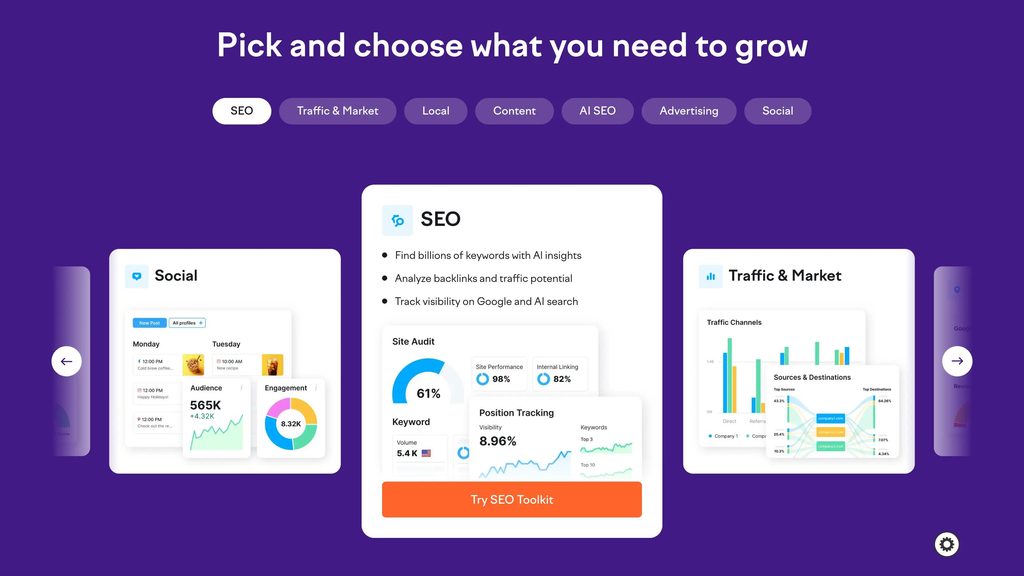
Marketers are not forced into the Semrush One bundle. Semrush continues to support SEO Classic plans alongside standalone, modular toolkits.
- SEO Classic (Pro at $139.95/mo, Guru at $249.95/mo, Business at $499.95/mo): Focuses strictly on traditional search engines, backlink databases, keyword tracking, and standard site audits without any LLM prompt tracking.
- Standalone AI Visibility Toolkit ($99/mo): Can be added à la carte to an existing SEO Classic plan or purchased independently.
- Local Toolkit ($30 to $60/mo per location): Delivers automated directory distribution, Google Business Profile management, local review aggregation, and hyper-local map rank tracking.
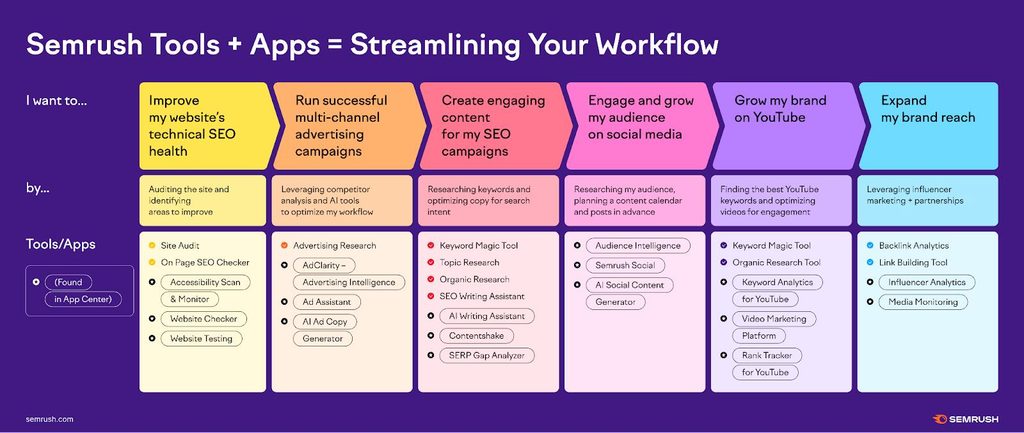
- Social Toolkit ($20 to $40/mo): Handles social post scheduling, competitor social benchmarking, and analytics across all major social networks.
- Content Toolkit: Unlocks SEO writing assistants, topic research maps, and automated content audit tools (included in Guru/Pro+ plans or available via targeted upgrades).
Financial Breakdown: Semrush One vs. The À La Carte Stack
Choosing between the two approaches often comes down to direct monthly software expenditure.
| Configuration Setup | What Is Included | Total Monthly Cost | Best Financial Fit |
| Semrush One Starter | SEO Pro limits + 50 AI prompts + AI Site Audit + Brand Performance (1 Domain) | $199.00 / mo | Small businesses and modern growth teams needing both SEO and AI tracking |
| SEO Classic Pro + Standalone AI Toolkit | SEO Pro limits + AI Visibility Toolkit add-on ($139.95 + $99) | $238.95 / mo | Marketers testing AI tracking on a legacy Pro plan |
| SEO Classic Pro (Alone) | Pure traditional SEO (Keywords, Backlinks, Audits, SERPs) | $139.95 / mo | Technical SEO purists and backlink builders |
| SEO Classic Pro + Local Toolkit (Base) | Core SEO + Local Map Rankings & Directory Listings ($139.95 + $30) | $169.95 / mo | Brick-and-mortar stores, local clinics, restaurants |
| Semrush One Pro+ | SEO Guru limits + Content Marketing tools + 100 AI prompts | $299.00 / mo | Content marketing teams and scaling SaaS brands |
The Value Math
If you are currently on an entry-level plan ($139.95/mo) and purchase the standalone AI Visibility Toolkit ($99/mo), your monthly bill is $238.95/mo. Upgrading directly to Semrush One Starter ($199/mo) delivers the exact same capabilities while saving you approximately $39.95 every month.
User Profile Analysis: Which Path Should You Choose?
Profile 1: The In-House Brand and Modern Growth Marketer
- The Verdict: Choose Semrush One.
- Why: Brand discovery in B2B and consumer tech happens increasingly inside conversational assistants. Tracking traditional SERP keywords without monitoring whether ChatGPT or Google AI Overviews cite your product leaves huge blind spots. Because Semrush One discounts the bundled AI features relative to the standalone add-on, it is the most economical, unified choice.
Profile 2: The Technical SEO Specialist and Site Auditor
- The Verdict: Choose SEO Classic (Pro or Guru).
- Why: If your daily deliverables center on crawl error remediation, JavaScript rendering, backlink outreach, and core web vitals, LLM sentiment scores and prompt research offer little immediate utility. Sticking with SEO Classic saves $60 to $100 per month on features you won’t open.
Profile 3: The Multi-Client Boutique Agency
- The Verdict: Evaluate carefully (SEO Classic + selective add-ons may win).
- Why: By default, Semrush One plans include AI Visibility brand tracking for only one primary domain. Monitoring AI brand performance for additional client domains incurs an extra fee of $99/month per domain. If an agency manages 10 distinct client brands, Semrush One can become expensive very quickly. For agencies, retaining a higher-tier SEO Classic plan (such as Guru or Business) and adding AI visibility only for premium retainers is often more profitable.
Profile 4: The Local Business and Brick-and-Mortar Shop
- The Verdict: Choose SEO Classic Pro + Local Toolkit.
- Why: For dental clinics, auto repair shops, and regional retailers, high placement on Google Maps and clean Apple/Bing directory citations drive the vast majority of calls and foot traffic. Pairing SEO Classic Pro ($139.95) with the Local Base toolkit ($30) costs $169.95/month, providing far more local value than global AI prompt monitoring.
Hidden Factors to Consider Before Upgrading
Before committing to a Semrush One plan, keep two key operational constraints in mind:
- The Single-Domain AI Brand Constraint: Semrush One includes full AI visibility metrics, but the deep Brand Performance and Sentiment reporting modules are calibrated for one domain out of the box. Extra domains require a $99/month license each.
- Single User Seats: Like all standard Semrush plans, Semrush One includes one user login by default. Adding teammates costs $45/mo on Starter, $80/mo on Pro+, and $100/mo on Advanced.
The Verdict: Is Semrush One Worth It in 2026?
If you manage an online brand, e-commerce store, or content platform where audience discovery is impacted by both search results and AI answer engines, Semrush One is undeniably worth it. It provides a streamlined dashboard combining traditional keyword ranks with modern prompt intelligence at a cheaper price point than purchasing SEO Classic and the AI Visibility Toolkit separately.
However, if your work is purely local, purely technical, or spread across dozens of client domains with separate reporting needs, sticking with a modular SEO Classic plan and layering on specific Local or Social toolkits remains the smarter, more cost-effective move.
Answering Your Queries!
What is the difference between Semrush One and SEO Classic?
Semrush One bundles traditional SEO features (keyword research, backlink audits, site crawls) with AI Visibility tracking for generative engines like ChatGPT and Gemini. SEO Classic plans focus purely on traditional search engines and exclude AI prompt monitoring.
Can I track more than one website’s AI Visibility on Semrush One?
Semrush One plans include AI brand performance tracking for one domain by default. You can track additional domains by purchasing add-on domain slots for $99 per month per domain.
If I already have an SEO Classic plan, do I have to switch to Semrush One?
No. You can remain on your current SEO Classic plan (Pro, Guru, or Business). If you later decide you want AI tracking, you can either upgrade to Semrush One or purchase the standalone AI Visibility Toolkit as an add-on.
Does Semrush One include the Local and Social Toolkits?
No. Semrush One specifically combines SEO and AI Visibility capabilities. The Local Toolkit (starting at $30/month per location) and the Social Media Toolkit (starting at $20/month) remain separate modular add-ons.
Does Semrush One tell me which websites AI models use to answer questions?
Yes. The Cited Sources report inside the AI Visibility suite identifies the exact URLs and domains that LLMs cite when generating answers for your tracked prompts, showing you where to build digital PR and brand mentions.