This article contains affiliate links. If you purchase or book through these links, we may earn a commission at no additional cost to you.
Search engine optimization is no longer confined to the traditional ten blue links. Today, a rapidly growing share of user journeys begins and ends entirely within conversational answer engines and generative summaries. When a prospective customer asks ChatGPT for software recommendations, queries Gemini for enterprise solutions, or triggers a Google AI Overview on a high-intent commercial search, your brand is either recommended, cited as an authority, or completely invisible.
This evolution has given rise to Generative Engine Optimization (GEO) and Answer Engine Optimization (AEO). However, optimizing for large language models (LLMs) without reliable tracking data is like doing traditional SEO without rank tracking.
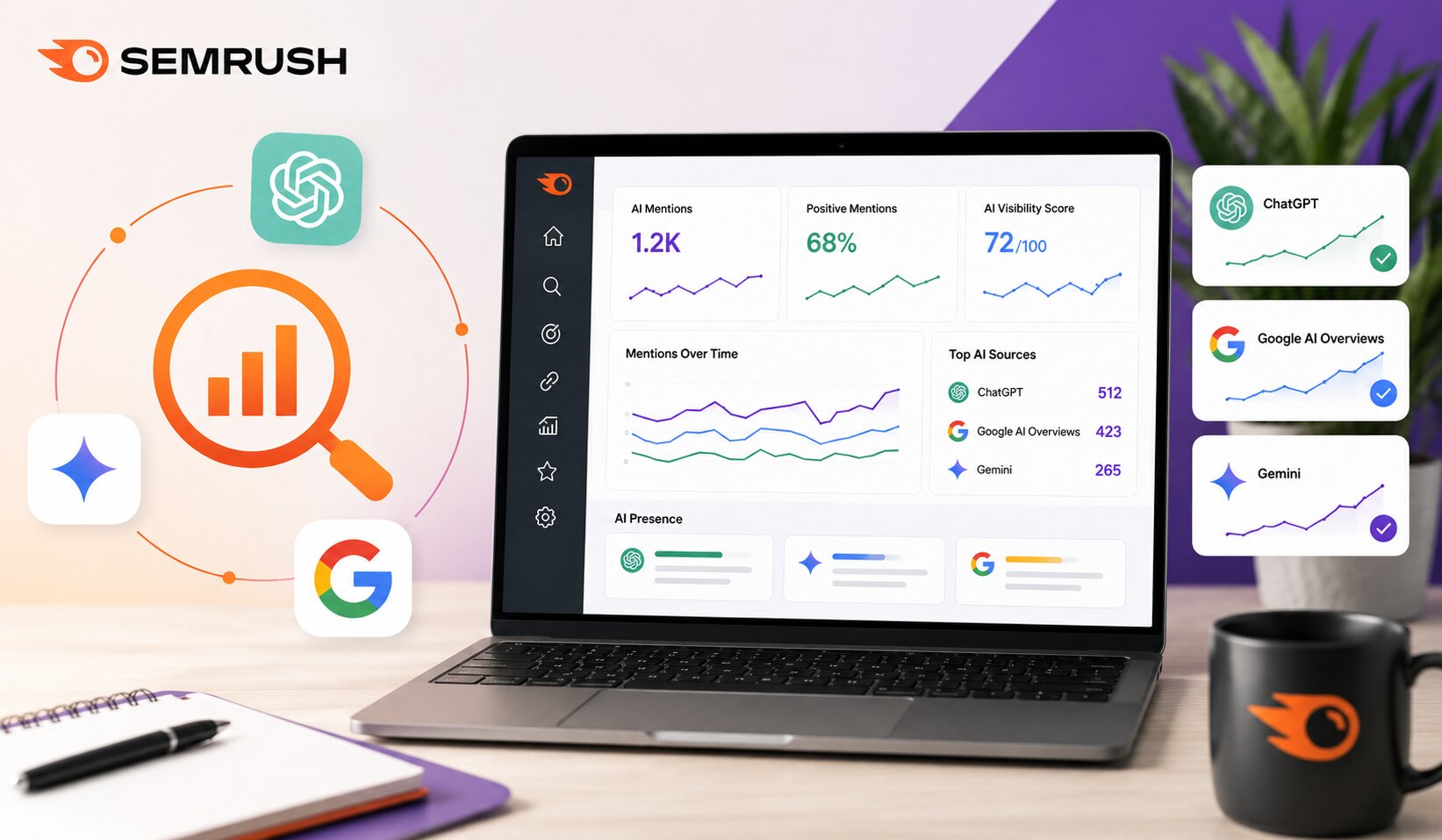
Recognizing this shift, Semrush expanded its analytics ecosystem to deliver dedicated AI tracking capabilities across major generative engines, including ChatGPT, Google Gemini, Google AI Overviews, and Google AI Mode.
This practical editorial guide walks you through measuring your brand’s AI search footprint, understanding core metrics like AI citations and Visibility Scores, auditing competitor positioning, and turning generative insights into actionable optimization strategies.
1. Why AI Search Visibility Demands a New Measurement Playbook
Traditional search rank tracking measures precise numerical positions on a Search Engine Results Page (SERP) based on indexed keywords. Generative engines operate on an entirely different architecture:
- Conversational Synthesis: AI engines do not merely return a list of matching URLs; they synthesize information from multiple underlying training sources and real-time retrieval mechanisms to construct a cohesive narrative answer.
- Zero-Click Decisions: Users often read the synthesized response directly in the chat or overview interface, making the presence of your brand name and key value propositions critical, even if the user does not immediately click through.
- Multi-Platform Fragmentation: A brand might be the primary recommendation in a Google AI Overview (grounded in Google’s real-time search index) while being entirely omitted by ChatGPT or Gemini when answering identical prompt intents.
To protect and expand your organic market share, tracking your brand across multiple AI search environments simultaneously has become essential. Semrush provides a consolidated interface to monitor these dynamic touchpoints at scale.
2. Core Metrics: What Semrush Tracks Across AI Search Engines
Tracking brand presence inside LLMs requires a distinct set of performance indicators. When setting up AI monitoring within Semrush, focus on these fundamental metrics:
Brand Mentions
A Brand Mention occurs whenever an AI model explicitly names your company, product, or service within its generated answer.
- Why it matters: LLMs frequently summarize categories by recommending top-tier tools or service providers. A direct mention establishes immediate brand awareness and positions your product as a recognized player in the category.
- What to look for: Track the sentiment and context of the mention. Is your brand introduced as a category leader, a budget alternative, or a specialized niche solution?
Citations & Source URLs
A Citation occurs when an AI engine embeds a clickable link or cites your domain as a reference source within its response or footnote drawer (such as the carousel cards in Google AI Overviews or linked footnotes in ChatGPT Search and Gemini).
- Why it matters: Citations are the direct drivers of high-intent referral traffic from AI engines. Furthermore, being consistently cited signals to search algorithms that your domain is a primary topical authority.
AI Visibility Score
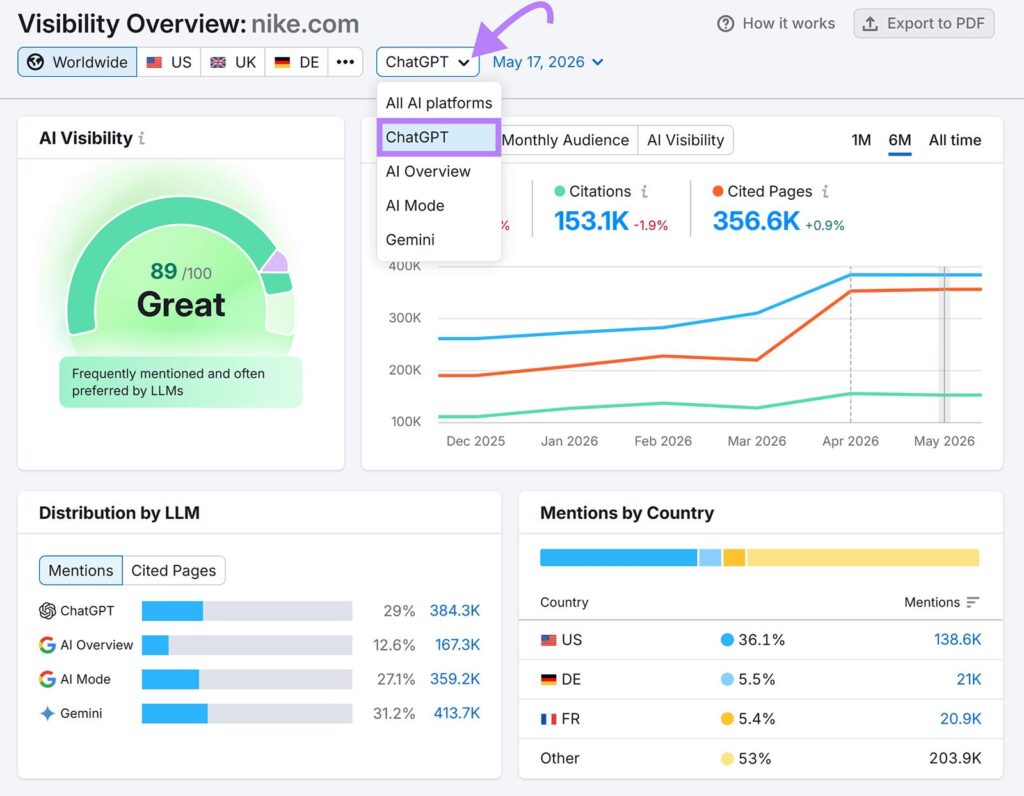
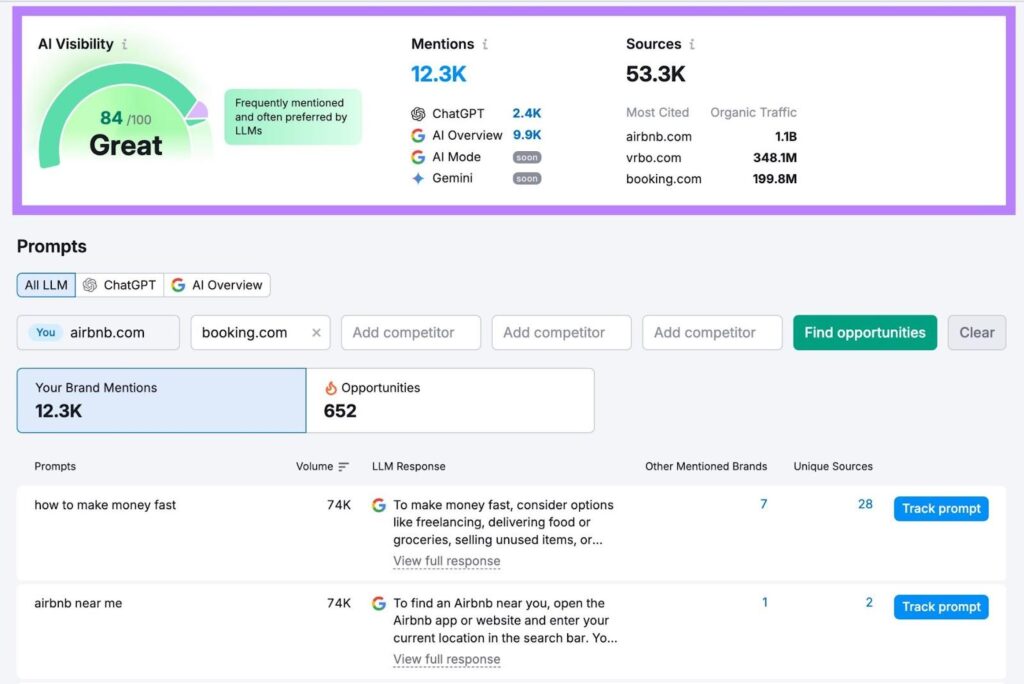
The AI Visibility Score is Semrush’s aggregate metric designed to reflect your brand’s overall prominence within generative responses across a target set of monitored prompts.
- How it is calculated: It weighs the frequency of your brand mentions, the prominence of your citations, and the positioning of your brand relative to competitors across tracked queries.
- Why it matters: It gives marketing leaders a single, benchmarkable health metric to evaluate whether their AEO efforts are trending upward over time.
3. Platform Breakdown: ChatGPT vs. Gemini vs. Google AI Overviews & AI Mode
Different AI engines gather and display source information differently. Understanding these nuances in Semrush allows for more accurate data interpretation.
| AI Platform | Data Retrieval Model | Citation & Mention Style | Key Tracking Objective |
| Google AI Overviews | Real-time Google Search Index | Interactive link cards, bulleted summaries, accordion sources | Protecting traditional top-ranking organic keywords from zero-click cannibalization |
| Google AI Mode | Conversational deep-dive search interface | Embedded citations, multi-turn dialogue sources | Capturing complex, multi-step buyer research journeys |
| ChatGPT | Web search retrieval + LLM synthesis | Footnote URLs, inline anchor links, markdown lists | Securing inclusion in direct conversational recommendations and listicles |
| Google Gemini | Google Knowledge Graph + Web grounding | Linked source bubbles, exportable response citations | Monitoring visibility within Google Workspace and multi-modal ecosystem queries |
4. Step-by-Step: Setting Up AI Visibility Tracking in Semrush
Setting up systematic AI tracking in Semrush requires structuring your prompt clusters to match real buyer intents. Follow these steps to build an actionable tracking project:
Step 1: Define Your Strategic Prompt Clusters
Rather than tracking generic single-word keywords, build a list of natural-language prompts reflecting the full marketing funnel:
- Informational / Explanatory: “How does [industry workflow] work?”
- Commercial Investigation: “What are the best [category] tools for mid-market teams?”
- Direct Comparison: “Brand A vs. Brand B vs. [Your Brand] pricing and features”
- Problem-Centric Solution: “How to solve [specific pain point] in 2026”
Step 2: Configure AI Engine Targets
Within the Semrush tracking interface, select the specific AI engines you want to monitor. Enable tracking across ChatGPT, Gemini, Google AI Overviews, and AI Mode for each prompt set to see cross-platform variances.
Step 3: Map Competitor Domains
Input your top 3 to 5 direct competitors. This enables Semrush to calculate your comparative Share of Model Voice and identify instances where competitors are cited on prompts where your domain is absent.
Step 4: Establish Baseline Benchmarks
Allow Semrush to run baseline queries across all selected engines. Record your initial AI Visibility Score, total brand mention count, and citation volume to measure progress over consecutive sprints.
5. Analyzing Competitor Comparisons: The “Share of Model Voice”
One of the most valuable capabilities of AI tracking in Semrush is identifying generative gaps between your brand and your competitors.
AI Share of Voice Audit
→ Gap Identified
A competitor is cited for a high-intent prompt, while your brand is missing.
→ Source Analysis
Semrush identifies the third-party review or publisher site being used as an LLM source.
→ Content Action
Publish superior data and pitch or update relevant third-party sources to strengthen your brand’s citations.
When auditing competitor visibility, examine three critical patterns:
- The Exclusivity Gap: Prompts where a competitor is cited exclusively, and your brand is entirely omitted. Semrush highlights the exact source URLs the engine referenced to formulate its answer, showing you precisely which digital assets you need to target or replicate.
- Third-Party Citation Intermediaries: AI models frequently cite third-party roundups, software directories, and editorial review sites rather than brand homepages. If Semrush shows competitors winning citations through a specific industry publication, getting featured in that exact publication becomes an immediate priority.
- Sentiment & Feature Disparities: If an AI engine repeatedly lists a competitor as “best for ease of use” while describing your product as “complex,” your positioning strategy needs adjustment across publicly indexable digital channels.
6. What Marketers Should Actually Do With the Data
Tracking metrics is useless without an operational workflow. Once Semrush highlights your AI visibility patterns, execute the following four optimization plays:
Play 1: Optimize for Direct Citation Retrieval
When Semrush reveals prompts where your site lacks citations despite relevant content, structure your pages to be easily parsed by AI retrieval agents:
- Add Clear Definitional Statements: Place concise, declarative definitions (40-60 words) immediately beneath primary subheadings.
- Utilize Structured Tables and Scannable Data: LLMs prioritize clean comparative tables and structured bullet points when extracting facts.
- Implement Schema Markup: Use precise Article, Product, Organization, and FAQ schema to help search crawlers verify authoritative entities.
Play 2: Target Third-Party Digital PR & Entity Building
Because generative engines lean heavily on consensus across the web, your owned media is only half the equation:
- Update External Directories: Ensure your profiles on verified review platforms and industry directories are complete and aligned with current offerings.
- Engage in Strategic Digital PR: Secure features, interviews, and brand mentions in authoritative industry publications that frequently appear in Semrush citation reports.
Play 3: Defend High-Traffic Keyword Clusters
If Google AI Overviews begin appearing on your highest-performing traditional organic search terms, check whether your domain is included in the Overview’s link carousel:
- If your organic URL is ranked #1 in traditional results but excluded from the AI Overview, restructure your introductory copy to directly answer the query intent in a concise, authoritative format.
Play 4: Build a Multi-Turn Prompt Strategy
In conversational interfaces like Google AI Mode and ChatGPT, users ask follow-up questions. Use Semrush’s related prompt intelligence to create comprehensive pillar pages that answer not only the initial question, but also the logical next three questions a buyer will ask.
7. The Future of AI Search Performance
The transition from classical search to conversational AI answers does not mean SEO is disappearing, it means SEO is maturing into comprehensive brand authority management.
By utilizing Semrush to track mentions, measure citations, benchmark visibility scores, and reverse-engineer competitor sources across ChatGPT, Gemini, Google AI Overviews, and AI Mode, marketing teams can move beyond guesswork. With reliable generative tracking in place, you can systematically optimize your brand to ensure it remains the definitive answer wherever your customers search.