For carpenters, plumbers, electricians, and serious DIY enthusiasts across the UK, a hand tool is never just a piece of metal with a handle. It is a daily extension of your trade, directly dictating how fast you finish a first-fix installation, how cleanly you set a hinge, and whether a stubborn screw strips out or turns smoothly.
Over the past few years, hand tool engineering has shifted dramatically. Manufacturers are no longer just tweaking handle colours; they are overhauling metallurgy, applying laser-etched tip microstructures, and engineering slimline insulation profiles.
Whether you are updating your everyday site tote or building out a new apprentice kit, the updated Toolstation Hand Tools range brings serious material upgrades to the shelves. Here is a comprehensive teardown of the newest hand tool specifications, what the engineering jargon actually means for your daily work, and how new arrivals from brands like Wera, Wiha, and Minotaur stack up on site.
1. Metallurgy Upgrades: Cr-V, Cr-Mo, and S2 Tool Steel
When browsing technical specs in the catalog, the steel alloy used in the tool’s core is the single most important factor determining longevity and torque transfer.
Chrome Vanadium Steel (Cr-V)
Chrome Vanadium remains the industry standard for high-tensile mechanics’ tools, combination spanners, and socket sets. The addition of chromium enhances corrosion resistance and hardenability, while vanadium provides structural grain refinement, preventing the steel from fracturing under sudden twisting forces.
The latest generation of Cr-V tools uses improved induction-hardening techniques around working jaws, delivering Rockwell Hardness ratings around HRC 54 to 58 without making the tool brittle.
Chrome Molybdenum Steel (Cr-Mo)
If you frequently use impact accessories or high-leverage water pump pliers, Chrome Molybdenum is the superior choice. Molybdenum significantly boosts impact resistance and torsional elasticity. When a bolt refuses to budge, a Cr-Mo tool absorbs high-torque shock loads that would snap or deform standard carbon steel.
S2 Modified Tool Steel
Found predominantly in high-performance screwdriver bits and precision drivers, S2 steel undergoes specialized heat treatment to reach hardness levels of HRC 58 to 62. S2 bits exhibit minimal tip deformation under continuous rotational load, drastically reducing the wear that leads to rounded screw heads.
2. Fastener Grip Technology: Laser Etching vs. Magnetic Tips
One of the most frequent frustrations on any job is cam-out, the phenomenon where a screwdriver tip slips upward out of the fastener recess, chewing up the screw head and marring the surrounding workpiece.
Fastener Fit Comparison:
Traditional Smooth Tip ──► Relies entirely on downward manual pressure ──► Prone to Cam-Out & Slippage
Laser-Etched Tip ──► Microscopic teeth “bite” into the screw walls ──► Locks in Place under High Torque
Premium arrivals from Wera feature patented Lasertip technology. Using focused laser beams, microscopic grooves with sharp edges are cut directly into the face of the drive tip. When you press the driver into a screw, these laser-machined ribs physically bite into the metal walls of the screw head.
This mechanical interlock achieves three major benefits:
- Reduces the required downward contact pressure by up to 30%.
- Prevents the screwdriver from slipping out and damaging delicate kitchen cabinetry or finished switchplates.
- Protects the driver tip from premature edge rounding.
3. VDE Electrical Insulation and Slim-Shaft Profiles
For electricians and maintenance technicians, electrical safety ratings are non-negotiable. Modern electrical hand tools must meet strict international standards, but recent engineering has solved a long-standing complaint among trade professionals: bulky insulation.
The Slim-Shaft Revolution
Historically, heavy VDE insulation added significant thickness around the driver shaft, making it almost impossible to access recessed terminal screws inside deep consumer units, junction boxes, or spring-clamp terminals without shaving down the plastic.
Newer VDE arrivals from Wiha (such as the SlimVarit series) and Wera (Kraftform Kompakt VDE) integrate the insulating material directly into the reduced-diameter steel blade. This delivers full 1,000V AC dielectric protection while maintaining an ultra-slim profile that reaches sunken terminal fixings without resistance.
Grip Ergonomics: Multi-Component Bi-Material Handles
Ergonomic science has advanced far beyond simple rubber sleeves. Modern hand tools feature multi-component handle geometries:
- Firm, smooth zones: Allow rapid repositioning and friction-free hand gliding during fast spin-down.
- Soft, tactile grip zones: Maximize friction across the palm for high torque transmission.
- Anti-roll hex shoulders: Prevent drivers, chisels, and pliers from rolling off stepladders or sloped work surfaces.
4. Key Specification Comparison
To see how these material specifications translate across different trade tools in the catalog, review the breakdown below:
| Feature / Spec | Entry-Level Utility Tools | Trade-Standard Cr-V | Premium Engineered (e.g., Wera / Wiha) |
| Primary Steel Grade | High-Carbon Steel | Chrome Vanadium (Cr-V) | Chrome-Vanadium-Molybdenum / S2 Steel |
| Hardness Rating | HRC 45 – 50 | HRC 54 – 58 | HRC 58 – 62 (Induction Hardened) |
| Tip Engineering | Plain Machined / Blackened | Magnetic Phosphate Finish | Laser-Etched Micro-Ribs / Diamond Coated |
| Insulation Standard | Basic PVC Sleeve (Non-VDE) | Standard 1000V VDE (Thick) | Integrated Slim-Shaft VDE (IEC 60900) |
| Grip Architecture | Single-injection plastic | Dual-component TPR rubber | Multi-zone anatomical (Anti-blister profile) |
| Target Application | Light domestic tasks | Everyday building & plumbing | Heavy trade, live testing, precision assembly |
5. Trade-Specific Tool Picks: What to Look For
For Electricians
Prioritize VDE-certified slim screwdrivers, bi-material cable shears with shear-cut jaws (preventing cable crushing), and automatic wire strippers with adjustable stop gauges. Explore dedicated VDE Screwdrivers & Sets to find insulated interchangeable blade kits that save weight in your service bag.
For Plumbers & Heating Engineers
Look for wide-jaw, rapid-adjust water pump pliers forged from oil-hardened Cr-Mo steel. Self-locking jaw geometries that grip pipes and nuts with three-point contact prevent slipping on smooth chrome fittings.
For Carpenters & Joiners
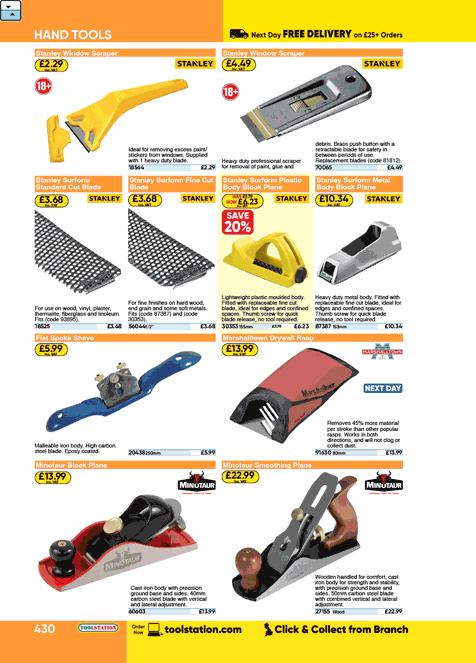
Focus on bevel-edge wood chisels forged from high-alloy ball-bearing steel (delivering superior edge retention) fitted with shatterproof split-proof acetate or steel-capped strike handles that withstand repeated mallet strikes.
Tool Box Essentials FAQ
Are Toolstation’s own-brand tools (Minotaur) as good as premium brands?
Toolstation’s Minotaur range is specifically engineered for trade durability at an accessible price point. For general daily maintenance, site demolition, framing, and rough-in tasks, Minotaur screwdrivers, hammers, and clamps deliver exceptional value and reliable Cr-V performance.
However, for specialized high-precision tasks, such as live electrical diagnostics, high-torque assembly, or continuous daily screw driving, premium brands like Wera, Wiha, or Knipex offer advantages in advanced metallurgy, patented anti-cam-out tips, and ergonomic fatigue reduction. A balanced toolkit often pairs Minotaur heavy-duty site tools with premium precision drivers.
Why do PZ (Pozidriv) and PH (Phillips) drivers look so similar, and why does mixing them up ruin screws?
While they look identical at a glance, Phillips (PH) screws have rounded internal corners designed to slip (cam-out) under extreme torque to prevent over-tightening in factory assembly lines. Pozidriv (PZ) screws feature four additional radial ribs between the main cross wings, allowing for parallel wall contact and much higher torque transfer.
Using a PH driver in a PZ screw (or vice versa) results in loose surface contact, immediately chewing up the screw head. Always match PZ with PZ and PH with PH!
What does “Drop Forged” actually mean on a tool specification sheet?
Drop forging involves shaping red-hot billet steel between precision dies under massive mechanical pressure. This process continuously aligns the metal’s internal crystal grain structure along the exact shape of the tool, eliminating microscopic internal air pockets and weak spots. A drop-forged tool is significantly stronger and more resistant to fatigue fractures than cast steel tools.
Why do some pliers feature an off-center joint rivet?
Known as High-Leverage Design, moving the pivot rivet just a few millimeters closer to the cutting blades changes the mechanical advantage of the lever. This reduces the hand-squeeze force required to cut thick copper cables or hardened piano wire by up to 35% compared to traditional centered-joint pliers.