
This article contains affiliate links. If you purchase or book through these links, we may earn a commission at no additional cost to you.
Most digital marketers view Semrush primarily as a keyword research and backlink analysis platform. While tracking search volume and ranking positions is essential, relying solely on keyword metrics creates a major strategic vulnerability: lagging data.
By the time a novel product, breakout consumer interest, or cultural shift registers a high monthly search volume in standard keyword databases, the market is already crowded. Early adopters have secured the top ranking spots, e-commerce storefronts have stocked their inventory, and major publishers have dominated news aggregators.
To truly lead your industry, you must spot demand while it is still forming.
By leveraging the Semrush Traffic & Market suite (including Market Explorer, Traffic Analytics, EyeOn, and One2Target), marketers, digital publishers, and e-commerce brands can uncover breakout market movements weeks or months before standard search tools register the shift. Here is a practical, step-by-step framework to identify emerging trends and build high-impact campaigns before your competitors catch on.
1. Map the Macro Landscape with Market Explorer
Trend discovery begins at the market level. Before evaluating individual websites or specific products, you must understand the broader trajectory of your industry and identify which market participants are expanding fastest.
Decoding the Growth Quadrant
When you enter an industry category or a custom competitor list of up to 100 domains into Market Explorer, the tool generates the Growth Quadrant. This matrix categorizes industry players into four quadrants based on their audience size and traffic growth rate:
- Leaders: High traffic volume and steady growth. These are the established category incumbents.
- Established Players: High traffic volume but slower, plateauing growth.
- Niche Players: Low overall traffic and modest growth rates, catering to specialized sub-segments.
- Game Changers: Low or medium baseline traffic paired with rapid, explosive growth rates.
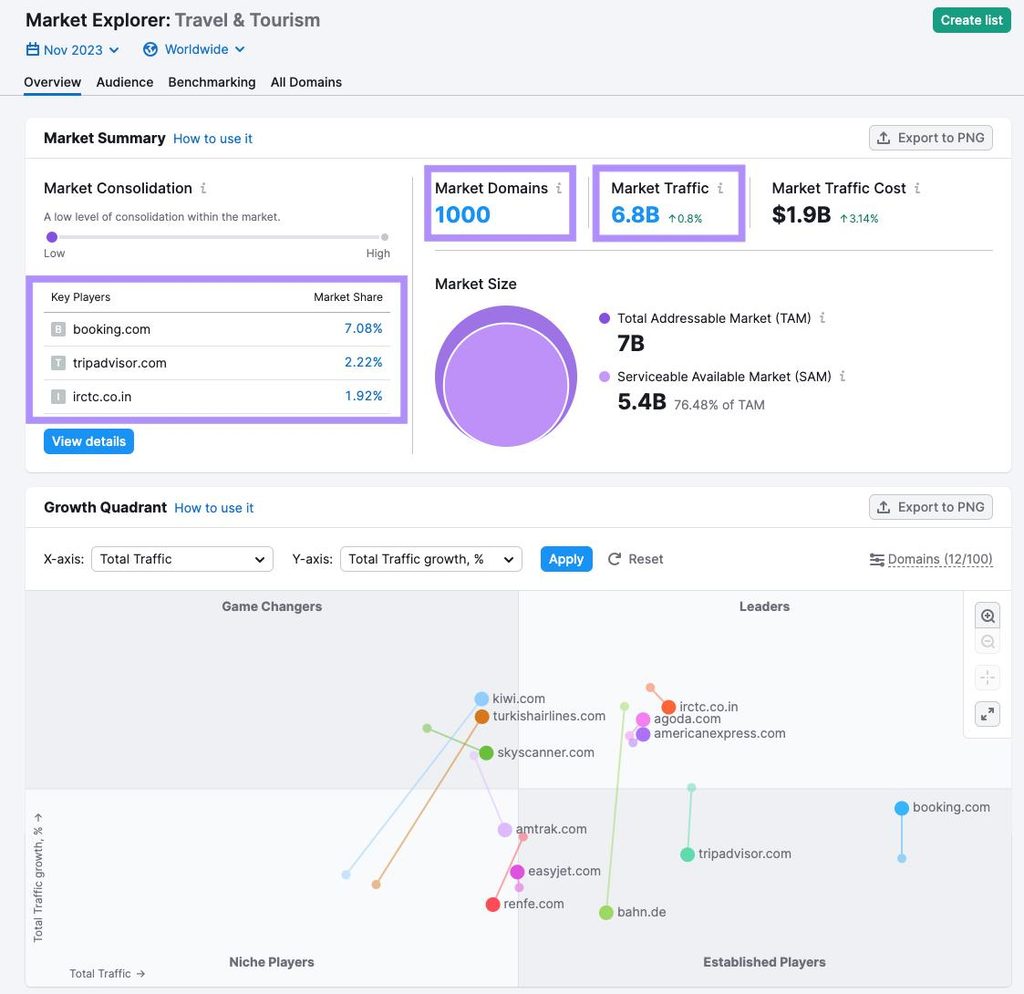
The Trend-Hunting Move: Pay close attention to the Game Changers quadrant. Fast-rising websites are the canaries in the coal mine. If a relatively unknown brand in your niche experiences a 150% quarter-over-quarter surge in web traffic, they have tapped into a consumer interest or product category that the legacy players have not yet addressed.
Industry Seasonality and Market Dynamics
Market Explorer also charts total addressable market traffic across 12-to-24-month cycles. For e-commerce merchandisers and lifestyle publishers, this visualizes macro seasonality. If total market traffic in a category begins rising two months earlier than historical norms, consumer buying intent is shifting forward, giving you the green light to launch upcoming seasonal promotions and gift guides ahead of schedule.
2. Uncover Breakout Topics via Competitor “Top Pages”
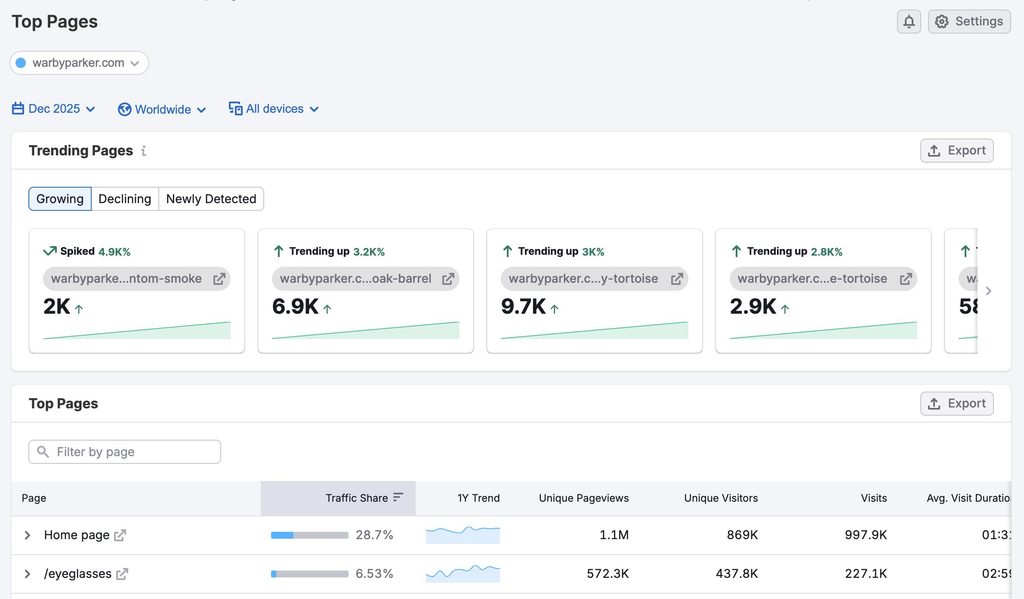
Once you identify the fastest-growing players in your space, the next step is diagnosing what is driving their sudden traffic surge. Rather than looking at their homepage, turn to the Top Pages report inside Traffic Analytics.
Spotting Sudden Spikes in URL Traffic
The Top Pages report breaks down estimated traffic at the individual URL, subfolder, and subdomain level.
- Filter by Growth Rate: Look at month-over-month (MoM) or quarter-over-quarter (QoQ) percentage changes in traffic for specific pages rather than total all-time traffic.
- Isolate New URL Paths: Look for new product landing pages, newly created blog categories, or product tags that did not exist three months ago.
- Examine the Traffic Channel Split: Check how traffic arrives at those spiking pages. If a new product page is seeing an influx of Direct and Referral traffic before organic search has even caught up, it signals word-of-mouth momentum or a viral social campaign.
How E-Commerce Brands Capitalize: If an apparel retailer notices three competing boutique sites suddenly generating tens of thousands of visits to newly indexed URLs containing specific materials or aesthetic tags (e.g., linen cargo pants or chunky silver loafers), the procurement team can secure relevant inventory before wholesalers run dry.
How Publishers Capitalize: If an editorial site sees rival publications driving traffic to newly launched explainer hubs or niche subdomains, editors can assign deep-dive guides and news roundups to capture early audience curiosity.
3. Map Where the Market Is Moving with “Traffic Journey”
Understanding where your target audience goes before and after visiting industry websites is one of the most effective ways to discover emerging platforms, referral networks, and adjacent interests.
Inside Traffic Analytics, navigate to the Traffic Journey report:
- Leading Traffic Sources: Identifies the top referring domains sending audience traffic to your competitors. If you notice a sudden rise in referral traffic coming from specific niche blogs, community forums, or specialized micro-influencer platforms, you have uncovered a new distribution channel.
- Destination Sites: Shows where users navigate after leaving your competitors’ pages. If a substantial percentage of visitors jump directly to a specific fintech checkout platform, a niche trade community, or a new social network, consumer behavior is shifting toward those endpoints.
By mapping these traffic flows, growth marketers can forge early co-marketing partnerships and secure ad placements on emerging referral sites while ad rates remain low.
4. Track Live Competitor Moves with EyeOn
Trend discovery is not just about historical analysis; it requires real-time situational awareness. Semrush EyeOn acts as an automated monitoring radar that watches your competitors’ day-to-day digital output.
What EyeOn Automatically Detects:
- Newly Published Blog Content: Instantly alerts you when rivals publish content around new topics, frameworks, or product comparisons.
- New Landing Pages & Category Additions: Signals when competitors quietly test new service lines or roll out beta features.
- New Ad Campaigns: Tracks changes in Google Search and display ad messaging across your competitor set.
When several competing brands simultaneously launch paid ad campaigns or content clusters around the same core theme, that theme is no longer an experiment, it is an emerging market priority.
5. Discover Audience Evolution with One2Target
Trends are fundamentally driven by people. As consumer demographics and socioeconomic preferences evolve, so do their buying and reading habits.
The One2Target tool aggregates cross-industry consumer behavior across four dimensions:
- Demographics: Shifts in the age and gender distribution across your industry’s audience base.
- Socioeconomics: Household income levels, employment status, and education levels.
- Behavior & Interests: Which digital platforms, media formats, and leisure topics the audience engages with most.
- Audience Overlap: The exact degree of shared visitors between your brand and both direct and indirect competitors.
If the audience profile of your vertical begins skewing younger or showing strong affinities for newly emerging digital services, you can adapt your editorial tone and creative assets to match their preferences well ahead of your competition.
The Strategic Trend-Hunting Playbook: By Industry
For E-Commerce & Retail
- The Strategy: Use Traffic Analytics to monitor the Top Pages of nimble, fast-fashion or boutique e-commerce brands.
- The Goal: Spot breakout product categories and styling shifts 4 to 6 weeks before high-volume search demand peaks, allowing your procurement team to negotiate stock and optimize product pages early.
For Digital Publishers & Media Outlets
- The Strategy: Use Market Explorer category benchmarks to identify breakout niche publications.
- The Goal: Detect trending news topics, cultural movements, and emerging sub-cultures before they reach mainstream discourse, ensuring your newsroom breaks stories first.
For B2B Marketers & Agencies
- The Strategy: Combine EyeOn competitive tracking with Traffic Journey destination analysis.
- The Goal: Identify new software integrations, operational frameworks, and marketing channels your enterprise clients should adopt before those tactics become saturated.
Answering Your Curiosity
What is the difference between keyword research and market trend analysis?
Keyword research looks at historical search volume to evaluate existing consumer queries. Market trend analysis examines real-time website traffic growth, audience behavior, and competitor movements. This allows you to spot emerging consumer interest before high search volume data is officially recorded in keyword databases.
Do I need to know who my competitors are to use Market Explorer?
No. Market Explorer provides an automated discovery option. You can simply input your own domain, and the tool will automatically identify your primary direct competitors, adjacent players, and rising industry leaders based on audience overlap and category dynamics.
How reliable is Semrush’s traffic data for smaller websites?
Semrush aggregates petabytes of anonymized clickstream data from a global panel of over 200 million users. While estimations are most accurate for mid-to-high traffic websites, the directional growth trends and percentage changes for smaller “Game Changer” domains are highly reliable for identifying breakout momentum.
Can I monitor non-traditional traffic sources like social media and AI referrals?
Yes. The Traffic Analytics channel distribution breakdown tracks visits originating from direct visits, search engines, paid campaigns, social networks, referral sites, email marketing, and emerging AI-assisted referral pathways.
How often does EyeOn send competitor activity reports?
EyeOn monitors competitor domains continuously and delivers automated email digests highlighting newly published pages, major blog updates, and promotional ad changes on a weekly cadence.